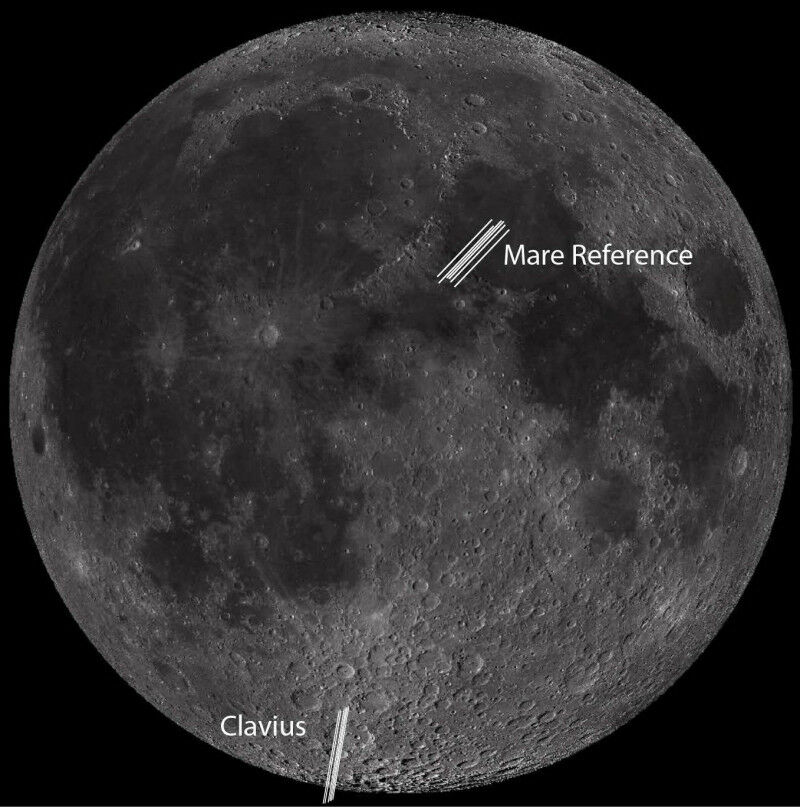
Water supply source for future space missions - publication in Nature Astronomy [Picture: Honniball et al]
Water supply source for future space missions - publication in Nature Astronomy [ Picture: Honniball et al] For the first time, the SOFIA (Stratospheric Observatory for Infrared Astronomy) flying observatory has provided direct and unambiguous evidence of water molecules on the moon beyond the permanent shadow at the poles. The infrared observatory, which is owned jointly by the US space agency NASA and the German Aerospace Center (DLR) was able to detect the molecules in the moon's southern hemisphere using the FORCAST (Faint Object InfraRed CAmera for the SOFIA-Telescope) instrument. On the German side, the scientific operation of SOFIA is coordinated by the University of Stuttgart's German SOFIA Institute (DSI). Scientists have been searching for unequivocal proof of water on the moon ever since the Apollo 11 mission brought the first lunar rocks back to Earth in 1969. These samples, however, as well as those recovered in the numerous follow-up missions, showed no clear evidence for the existence of water on the Earth's satellite. Only in 2009 was final confirmation found by NASA's Moon Mineralogy Mapper on board the Indian Chandrayaan-1 mission, and only at the regions surrounding the moon's poles. "Using SOFIA," explains Bernhard Schulz, SOFIA Science Mission Operation Deputy Director at the University of Stuttgart, "we've finally succeeded in providing the long hoped-for clear proof that water also occurs in the warmer areas of the lunar surface illuminated by the sun." A team led by Casey Honniball of the Hawai'i Institute of Geophysics and Planetology had already used the FORCAST instrument on board SOFIA to make observations of the moon on the 30th of August 2018.
TO READ THIS ARTICLE, CREATE YOUR ACCOUNT
And extend your reading, free of charge and with no commitment.