Physicists at the University of Stuttgart detect individual nuclear spins with single rare-earth ions in crystals
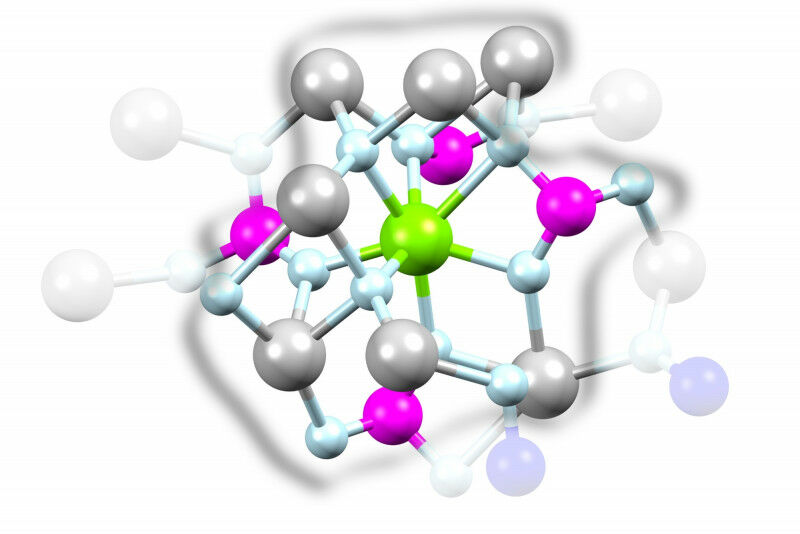
Physicists at the University of Stuttgart detect individual nuclear spins with single rare-earth ions in crystals Crystals doped with rare-earths are currently used in batteries, LEDs, magnets, lasers, and much more. So far, the detection of single nuclear spins close-by a rare-earth electron spins was not feasible. Researchers at 3rd Institute of Physics, University of Stuttgart and colleagues from Beijing Computational Science Research Center now used the rare-earth cerium to measure individual silicon nuclear spins, located in the crystal lattice in close proximity to cerium. Applications based on rare-earths rely on their unique properties, such as electron spins, which can potentially provide a direct interface between robust spin quantum bits and telecom band photons. Especially long-lived nuclear spins could carry out essential memory tasks as spin quantum bits one day, and could ultimately enable powerful quantum computers. "If you consider addressable single nuclear spins as a potentially useful resource in quantum technologies, such as quantum error correction schemes, then sensing them based on single rare-earth ions provides access to a broad range of materials, that can now be considered for quantum applications," Thomas Kornher explains, scientific staff at 3rd Physics Institute. "The broad range of new materials is based on the versatile doping of rare-earth ions into solid state hosts, which is a well-studied field building on investigations into laser physics." In their study, circularly polarized light was focused onto a micrometer-sized spot, which allowed the researchers to excite cerium-related electrons into a specific energy and spin state.
TO READ THIS ARTICLE, CREATE YOUR ACCOUNT
And extend your reading, free of charge and with no commitment.