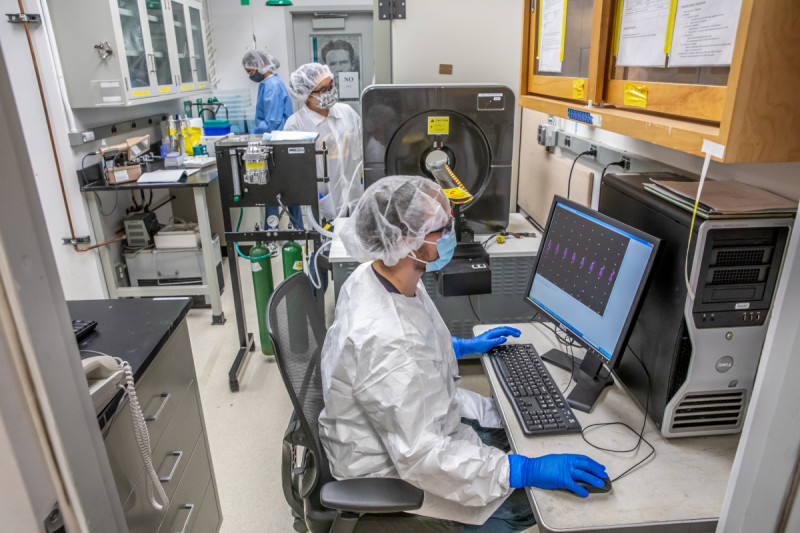
Katherine Shield (from left), Dahlia An, and Tyler Bailey are part of a research team that developed new methods for the large-scale production, purification, and use of the radioisotope cerium-134, which could serve as a tunable PET imaging surrogate for several alpha-emitting isotopes for targeted cancer therapies. Their findings were reported today. (Credit: Marilyn Sargent/Berkeley Lab)
Katherine Shield ( from left ), Dahlia An, and Tyler Bailey are part of a research team that developed new methods for the large-scale production, purification, and use of the radioisotope cerium-134, which could serve as a tunable PET imaging surrogate for several alpha-emitting isotopes for targeted cancer therapies. Their findings were reported today. (Credit: Marilyn Sargent/Berkeley Lab) - New methods could lead to single-molecular systems for both diagnosing and treating cancer in real time A promising approach to treating cancer - called targeted alpha-particle therapy or TAT - could better harness the curative power of radiation treatments and lessen the severity of their more debilitating side effects. TAT recruits drugs containing radioactive materials called alpha-emitting radioisotopes or combined with cell-targeting molecules like antibodies. As alpha-emitting radioisotopes decay, they emit radiation in the form of highly energetic particles called alpha particles. Cell-targeting antibodies guide these alpha-emitting radioisotopes, like super-tiny guided missiles, to their final destination: cancer cells. While interest in TAT has grown, clinicians do not have a good method for monitoring whether these drugs actually hit the targeted cancer cells once they've entered a patient's bloodstream.
TO READ THIS ARTICLE, CREATE YOUR ACCOUNT
And extend your reading, free of charge and with no commitment.