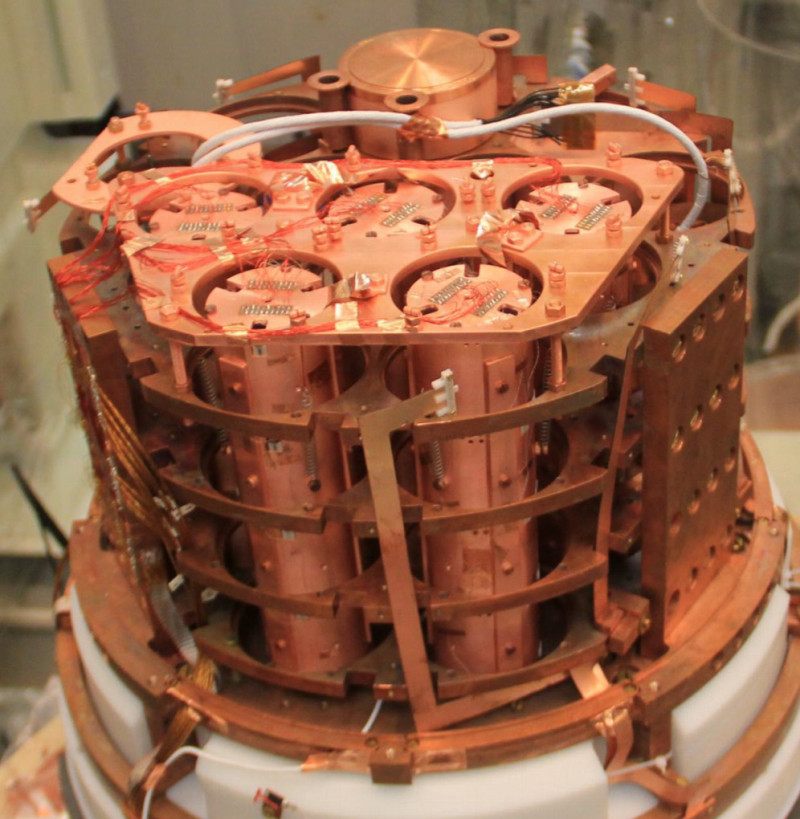
The CUPID-Mo detector is installed in the Edelweiss cryostat at Modane Underground Laboratory (LSM) in France. (Credit: CUPID-Mo collaboration)
The CUPID-Mo detector is installed in the Edelweiss cryostat at Modane Underground Laboratory (LSM) in France. (Credit: CUPID-Mo collaboration) - Berkeley Lab researchers are part of an international team that reports a high-sensitivity measurement by underground CUPID-Mo experiment Nuclear physicists affiliated with the U.S. Department of Energy's Lawrence Berkeley National Laboratory (Berkeley Lab) played a leading role in analyzing data for a demonstration experiment that has achieved record precision for a specialized detector material. The CUPID-Mo experiment is among a field of experiments that are using a variety of approaches to detect a theorized particle process, called neutrinoless double-beta decay, that could revise our understanding of ghostly particles called neutrinos, and of their role in the formation of the universe. The preliminary results from the CUPID-Mo experiment, based on the Berkeley Lab-led analysis of data collected from March 2019 to April 2020, set a new world-leading limit for the neutrinoless double-beta decay process in an isotope of molybdenum known as Mo-100. Isotopes are forms of an element that carry a different number of uncharged particles called neutrons in their atomic nuclei. The new result sets the limit on the neutrinoless double-beta decay half-life in Mo-100 at 1.4 times a trillion-trillion years (that's 14 followed by 23 zeros), which is a 30% improvement in sensitivity over the Neutrino Ettore Majorana Observatory 3 (NEMO 3) , a previous experiment that operated at the same site from 2003-2011 and also used Mo-100.
TO READ THIS ARTICLE, CREATE YOUR ACCOUNT
And extend your reading, free of charge and with no commitment.