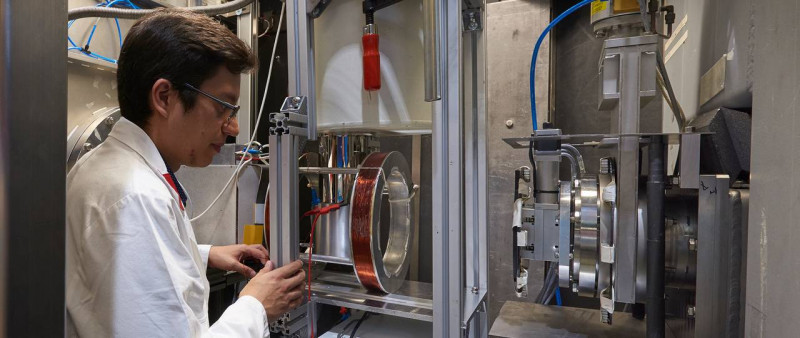
Lester Barnsley, instrument scientist at Forschungszentrum Jülich, at the small-angle neutron scattering system KWS-1 of the Heinz Maier-Leibnitz Zentrum at the Heinz Maier-Leibnitz Research Neutron Source (FRM II) at the Technical University of Munich. Image: R. Müller / TUM
Lester Barnsley, instrument scientist at Forschungszentrum Jülich, at the small-angle neutron scattering system KWS-1 of the Heinz Maier-Leibnitz Zentrum at the Heinz Maier-Leibnitz Research Neutron Source (FRM II) at the Technical University of Munich. Image: R. Müller / TUM Neutrons make structural changes in molecular brushes visible - They look like microscopic bottle brushes: Polymers with a backbone and tufts of side arms. This molecular design gives them unusual abilities: For example, they can bind active agents and release them again when the temperature changes. With the help of neutrons, a research team from the Technical University of Munich (TUM) has now succeeded to unveil the changes in the internal structure in course of the process. "The structure of the bottle-brush polymers, which are only nanometers in size, cannot be investigated using classical optical methods: It can be seen that an aqueous solution containing these polymers becomes turbid at a certain temperature. But why this is the case, and how the backbone and the side arms stretch out into in the water or contract, has not yet been clarified," reports Prof. Christine Papadakis. There is a simple reason why scientists would like to know more about the inner life of bottle-brush polymers: The fluffy molecules, which consist of different polymer chains and abruptly change their solubility in water at a certain temperature, are promising candidates for a variety of applications.
TO READ THIS ARTICLE, CREATE YOUR ACCOUNT
And extend your reading, free of charge and with no commitment.