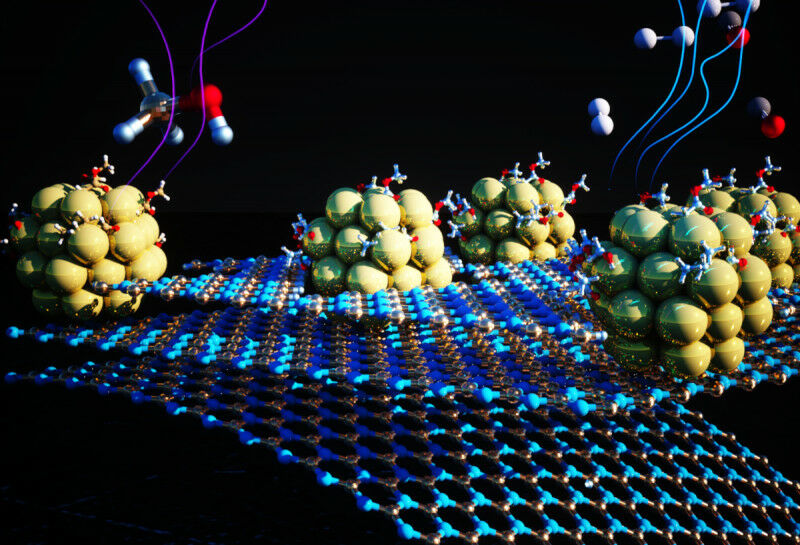
Illustration of the 2D boron nitride substrate with imperfections that host tiny nickel clusters. The catalyst aids the chemical reaction that removes hydrogen from liquid chemical carriers, making it available for use as a fuel. (Credit: Jeff Urban/Berkeley Lab)
Illustration of the 2D boron nitride substrate with imperfections that host tiny nickel clusters. The catalyst aids the chemical reaction that removes hydrogen from liquid chemical carriers, making it available for use as a fuel. (Credit: Jeff Urban/Berkeley Lab) - A new nanomaterial helps obtain hydrogen from a liquid energy carrier, in a key step toward a stable and clean fuel source Hydrogen is a sustainable source of clean energy that avoids toxic emissions and can add value to multiple sectors in the economy including transportation, power generation, metals manufacturing, among others. Technologies for storing and transporting hydrogen bridge the gap between sustainable energy production and fuel use, and therefore are an essential component of a viable hydrogen economy. But traditional means of storage and transportation are expensive and susceptible to contamination. As a result, researchers are searching for alternative techniques that are reliable, low-cost and simple. More-efficient hydrogen delivery systems would benefit many applications such as stationary power, portable power, and mobile vehicle industries.
TO READ THIS ARTICLE, CREATE YOUR ACCOUNT
And extend your reading, free of charge and with no commitment.