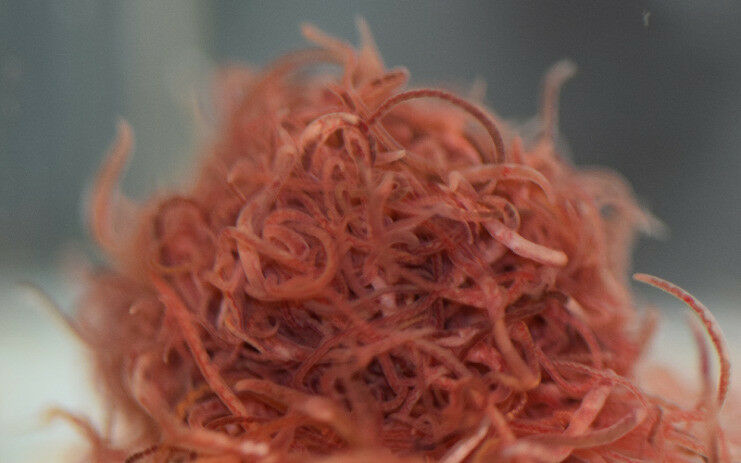
Tubifex worms. Image: A. Deblais, UvA.
Tubifex worms. Image: A. Deblais, UvA. Active motion of worms may help develop new polymer physics 26 May 2020 By performing experiments on Tubifex worms bought at the local pet shop, researchers at the University of Amsterdam (UvA) have discovered that the wiggling motion of living worms gives rise to surprising physics. The way the worms spontaneously organise themselves into a blob turns out to be different from the aggregation of randomly moving particles that is well-known to physicists. Furthermore, the worm-blob behaves like a liquid, with a viscosity that depends on the applied shear force in a unique manner. The research has been published in two papers in Physical Review Letters. Tubifex worms are thin, wiggling creatures that look somewhat like polymer molecules - at least in the eyes of physicist Daniel Bonn and physical chemist Sander Woutersen.
TO READ THIS ARTICLE, CREATE YOUR ACCOUNT
And extend your reading, free of charge and with no commitment.