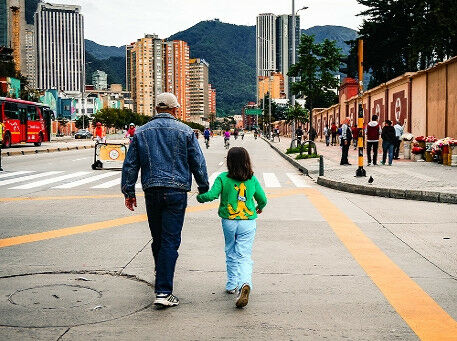
Ciclovia, Bogota, Colombia, 2017
Ciclovia, Bogota, Colombia, 2017 - For a long time the car appeared to be the dominant force in urban streets but, increasingly, we are seeing experiments which aim to design streets as places for people. Especially now that our use of public spaces is changing so significantly. UvA researcher Luca Bertolini has investigated the impacts of 'street experiments' and draws lessons for urban policy. Globally we are witnessing a wealth of experiments which aim to make streets more enjoyable for people. These experiments were happening before the crisis but the crisis has given rise to a veritable explosion in street experiments. Sometimes entire streets are converted into 'streets for people', where cars are no longer welcome and residents are given priority. So far, says Mobility and Urban Planning researcher Luca Bertolini, what has been missing is a good comparison between street experiments and lessons that we can draw from them in terms of systemic changes in urban mobility. In the academic journal Transport Reviews , Bertolini compares a number of experiments and comes to the conclusion that policymakers should incorporate the successful aspects of urban street experiments into long-term plans and policy so they can understand them better and utilise them more effectively. Bertolini focuses on street experiments in which intentional temporary changes to street use are implemented to make 'streets for traffic' into 'streets for people'. What are their main characteristics and impacts?
TO READ THIS ARTICLE, CREATE YOUR ACCOUNT
And extend your reading, free of charge and with no commitment.