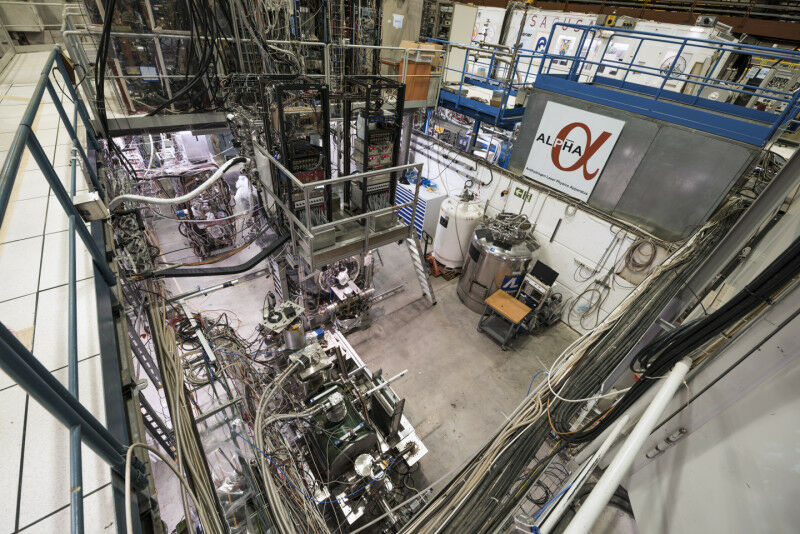
View of the ALPHA experiment (Image: CERN)
View of the ALPHA experiment (Image: CERN) - Geneva, 31 March 2021. The ALPHA collaboration at CERN has succeeded in cooling down antihydrogen atoms - the simplest form of atomic antimatter - using laser light. The technique, known as laser cooling, was first demonstrated 40 years ago on normal matter and is a mainstay of many research fields. Its first application to antihydrogen by ALPHA, described in a paper published today in Nature , opens the door to considerably more precise measurements of the internal structure of antihydrogen and of how it behaves under the influence of gravity. Comparing such measurements with those of the well-studied hydrogen atom could reveal differences between matter and antimatter atoms. Such differences, if present, could shed light on why the universe is made up of matter only, an imbalance known as matter-antimatter asymmetry. "The ability to laser-cool antihydrogen atoms is a game-changer for spectroscopic and gravitational measurements, and it could lead to new perspectives in antimatter research, such as the creation of antimatter molecules and the development of anti-atom interferometry," says ALPHA spokesperson, Jeffrey Hangst.
TO READ THIS ARTICLE, CREATE YOUR ACCOUNT
And extend your reading, free of charge and with no commitment.