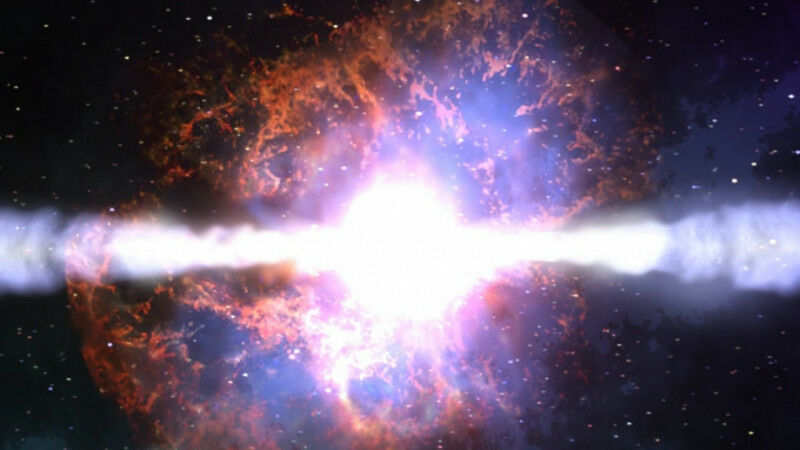
An artist's impression of a hypernova explosion. Image: NASA
An artist's impression of a hypernova explosion. Image: NASA - In a world-first, astronomers from The Australian National University (ANU) have discovered evidence of a massive explosion that led to the destruction of a rapidly spinning, strongly-magnetized star. The so-called "magneto-rotational hypernova" occurred around a billion years after the Big Bang and was 10-times more energetic than a supernova. The breakthrough discovery, led by an international team of scientists, offers clues for why an unusually high concentration of metal elements were present in another ancient Milky Way star. The star, SMSS J200322.54-114203.3, had higher amounts of zinc, uranium and europium, compared to the first stars in the universe which were predominantly made up of hydrogen and helium. "We calculate that 13-billion-years ago, J200322.54-114203.3 formed out of a chemical soup that contained the remains of this type of hypernova," Dr David Yong, from the ANU Research School of Astronomy and Astrophysics, said. "No one's ever found this phenomenon before.
TO READ THIS ARTICLE, CREATE YOUR ACCOUNT
And extend your reading, free of charge and with no commitment.