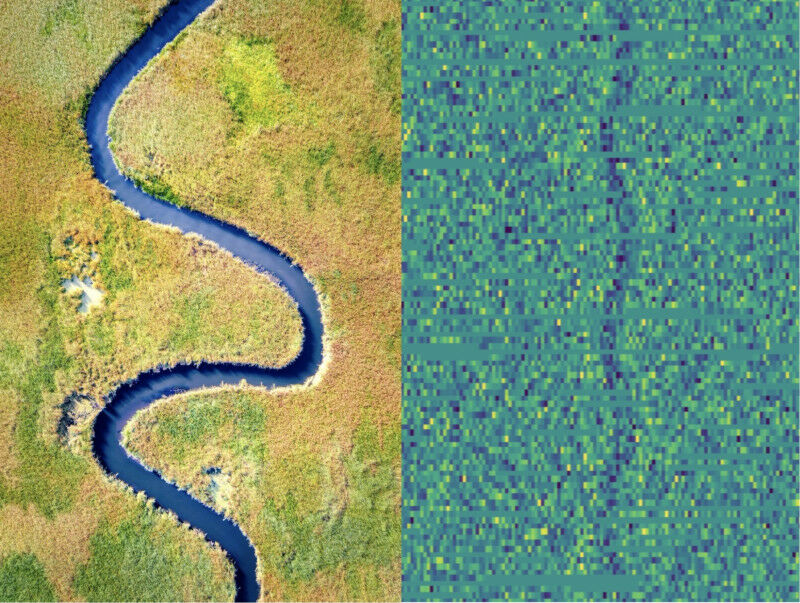
 The method uses a data representation where the presence of a planet (right) is seen as a river in the sky (left). The image on the right shows the measured luminous flux of the star Kepler-36 with the plot of eclipses due to the planet Kepler-36 b.
The method uses a data representation where the presence of a planet ( right ) is seen as a river in the sky ( left ). The image on the right shows the measured luminous flux of the star Kepler-36 with the plot of eclipses due to the planet Kepler-36 b. UNIGE, Dave Hoefler - By implementing artificial intelligence techniques similar to those used in autonomous cars, a team from the UNIGE and the UniBE, in partnership with the company Disaitek, has discovered a new method for detecting exoplanets. The majority of exoplanets discovered to date have been discovered using the transit method. This technique is based on a mini eclipse caused when a planet passes in front of its star. The decrease in luminosity observed makes it possible to deduce the existence of a planet and to estimate its diameter, after the observations have been periodically confirmed. However, theory predicts that in many planetary systems, interactions between planets alter this periodicity and make their detection impossible. It is in this context that a team of astronomers from the University of Geneva (UNIGE), the University of Bern (UniBE), and the NCCR PlanetS, Switzerland, in collaboration with the company Disaitek, used artificial intelligence (AI) applied to image recognition.
TO READ THIS ARTICLE, CREATE YOUR ACCOUNT
And extend your reading, free of charge and with no commitment.
Your Benefits
- Access to all content
- Receive newsmails for news and jobs
- Post ads