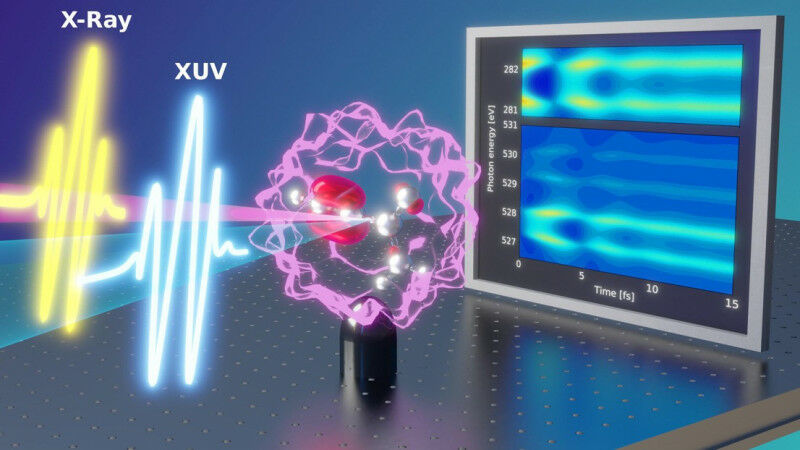
Fingerprints of ultrafast electron-nuclear dynamics obtained with attosecond transient absorption spectroscopy. Credit: N. Golubev, EPFL
Fingerprints of ultrafast electron-nuclear dynamics obtained with attosecond transient absorption spectroscopy. Credit: N. Golubev, EPFL - Scientists at EPFL have shown that the powerful transient absorption spectroscopy technique can unravel ultrafast motion of electrons and nuclei in a molecule in real time and with atomic spatial resolution. The last few decades have seen impressive progress in laser-based technologies, which have led to significant advancements in atomic and molecular physics. The development of ultrashort laser pulses now allows scientists to study extremely fast phenomena, like charge transport in molecules and elementary steps of chemical reactions. But beyond that, our ability to observe such processes on the attosecond scale (one quintillionth of a second) means that it is also possible to steer and probe the dynamics of individual electrons on their natural timeframes. One of the emerging ultrafast technologies is attosecond transient absorption spectroscopy (ATAS), which can track the movement of electrons at a specific site of a molecule. This is a particularly appealing feature of ATAS, because it permits tracing the evolution of the molecular system with spatial resolution at the atomic scale.
TO READ THIS ARTICLE, CREATE YOUR ACCOUNT
And extend your reading, free of charge and with no commitment.