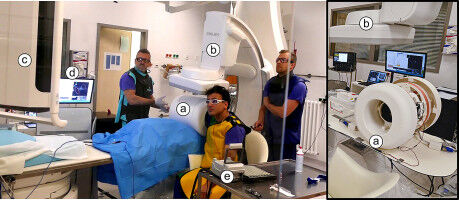
The ring magnet at Fermilab used for the muon g-2 experiment. © Fermilab /
The ring magnet at Fermilab used for the muon g-2 experiment. Fermilab / Image: Reidar Hahn - The US research laboratory "Fermilab" has published the eagerly awaited results of the experimental measurement of the so-called anomalous magnetic dipole moment of the muon. As members of the "Muon g-2 Theory Initiative", researchers from the University of Bern have calculated the same physical quantity theoretically in parallel, based on the Standard Model. The deviation of the experimental measurement from the theoretical calculation could indicate the existence of new particles. The results of a new, highly precise experimental measurement of the so-called anomalous magnetic dipole moment of the muon were published today at the US research laboratory 'Fermilab'. The result was eagerly awaited, as a comparison between experimental measurement of the anomalous magnetic dipole moment and the theoretical calculation of the same quantity can provide clues as to whether the Standard Model of particle physics - which describes the known elementary particles and their interactions - may need to be extended. This could be done, for example, by adding new particles to the Standard Model.
TO READ THIS ARTICLE, CREATE YOUR ACCOUNT
And extend your reading, free of charge and with no commitment.
Your Benefits
- Access to all content
- Receive newsmails for news and jobs
- Post ads