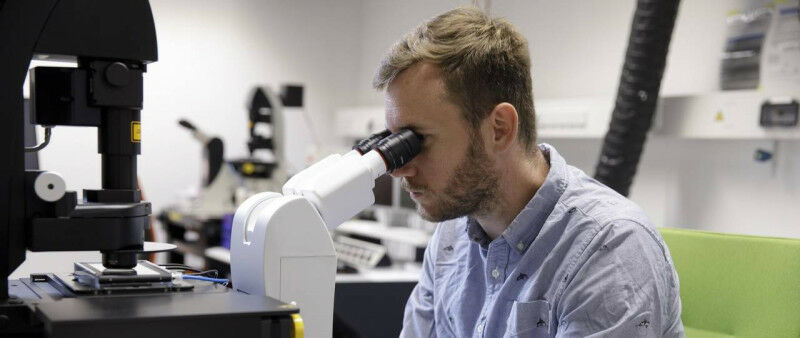
First author Benedikt Buchmann at the microscope. Through time-resolved observation of the cells, the research team was able to investigate the interactions between the organoid cells and the surrounding collagen in detail. Image: M. Kratzer / TUM
First author Benedikt Buchmann at the microscope. Through time-resolved observation of the cells, the research team was able to investigate the interactions between the organoid cells and the surrounding collagen in detail. Image: M. Kratzer / TUM Organoids help understand the complex interactions of cells and tissue - In addition to chemical factors, mechanical influences play an important role in the natural growth of human organs such as kidneys, lungs and mammary glands - but also in the development of tumors. Now a research team at the Technical University of Munich (TUM) has investigated the process in detail using organoids, three-dimensional model systems of such organs which are produced in the laboratory. Organoids are three-dimensional systems modeling various human organs. Grown in the laboratory, they exhibit properties similar to those of actual body tissue. Organoids offer science new opportunities to simulate and investigate the processes of organ growth.
TO READ THIS ARTICLE, CREATE YOUR ACCOUNT
And extend your reading, free of charge and with no commitment.