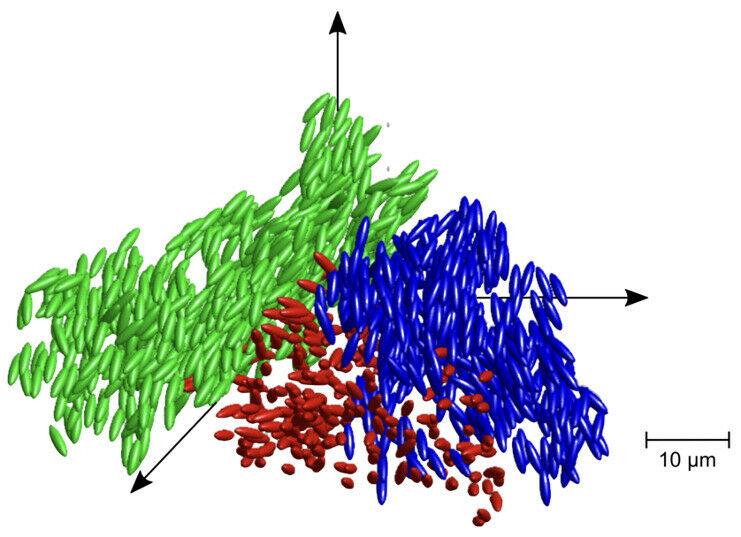
The new glass state is made out of ellipsoidal colloids. Image: U. Konstanz.
The new glass state is made out of ellipsoidal colloids. Image: U. Konstanz. An interdisciplinary team of researchers from the Universities of Konstanz and Amsterdam have uncovered a new state of matter, liquid glass, with previously unknown structural elements. The discovery leads to new insights into the nature of glass and its transitions. While glass is a truly ubiquitous material that we use on a daily basis, it also represents a major scientific conundrum. Contrary to what one might expect, the true nature of glass remains something of a mystery, with scientific inquiry into its chemical and physical properties still underway. In chemistry and physics, the term 'glass' itself is a mutable concept: it includes the substance we know as window glass, but it may also refer to a range of other materials with properties that can be explained by reference to glass-like behaviour, including, for instance, metals, plastics, proteins, and even biological cells.
TO READ THIS ARTICLE, CREATE YOUR ACCOUNT
And extend your reading, free of charge and with no commitment.