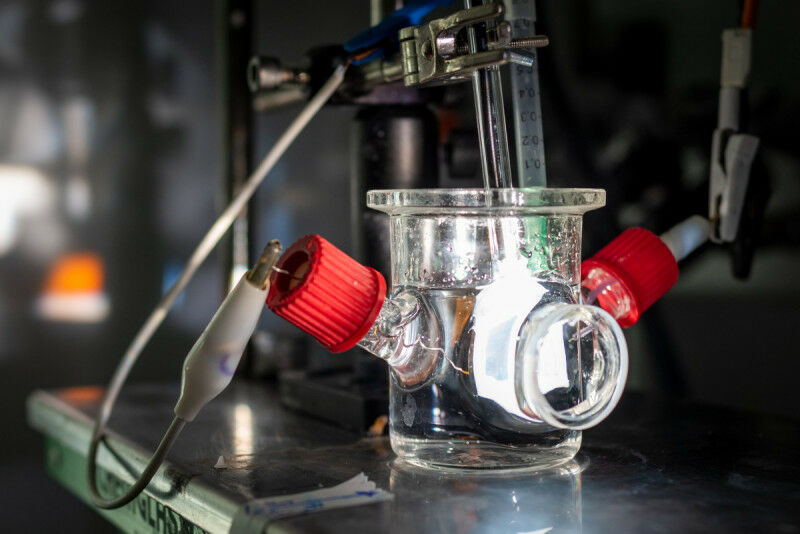
A model solar fuels device called a photoelectrochemical cell. A research team led by Francesca Toma, a staff scientist at the Liquid Sunlight Alliance in Berkeley Lab’s Chemical Sciences Division, designed the model. (Credit: Thor Swift/Berkeley Lab)
A model solar fuels device called a photoelectrochemical cell. A research team led by Francesca Toma, a staff scientist at the Liquid Sunlight Alliance in Berkeley Lab's Chemical Sciences Division, designed the model. (Credit: Thor Swift/Berkeley Lab) - Discovery significantly improves stability in ethylene and hydrogen production via artificial photosynthesis - A research team has developed a new artificial photosynthesis DEVICE COMPONENT with remarkable stability and longevity as it selectively converts sunlight and carbon dioxide into two promising sources of renewable fuels - ethylene and hydrogen. The researchers' findings, which they recently reported Energy , reveal how the device degrades with use, then demonstrate how to mitigate it. The authors also provide new insight into how electrons and charge carriers called "holes" contribute to degradation in artificial photosynthesis. "By understanding how materials and devices transform under operation, we can design approaches that are more durable and thus reduce waste," said senior author Francesca Toma , a staff scientist in the Liquid Sunlight Alliance (LiSA) and Berkeley Lab's Chemical Sciences Division. For the current study, Toma and her team designed a model solar fuels device known as a photoelectrochemical (PEC) cell made of copper(I) oxide or cuprous oxide (Cu2O), a promising artificial photosynthesis material.
TO READ THIS ARTICLE, CREATE YOUR ACCOUNT
And extend your reading, free of charge and with no commitment.