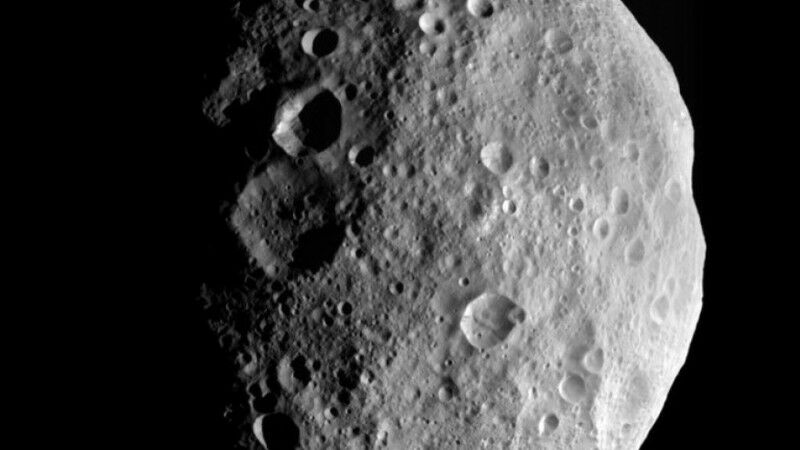
The trajectory of 2018LA leads back to Vesta (pictured), the second-largest asteroid in the Solar System. Image credit: NASA/JPL-Caltech/UCLA/MPS/DLR/IDA
The trajectory of 2018LA leads back to Vesta (pictured), the second-largest asteroid in the Solar System. Image credit: NASA/JPL-Caltech/UCLA/MPS/DLR/IDA - An international team of scientists has reconstructed the 22-million-year journey of an asteroid through the Solar System to its impact on Earth. The research on the flight path of the asteroid, which landed in the Kalahari Desert in Botswana on 2 June 2018, is the first time that scientists have precisely mapped a meteorite's voyage to Earth. The breakthrough offers new insights into the Solar System's ancient past, including a better understanding of its second-largest asteroid and the only one visible to the naked eye. NASA Ames Research Center and the SETI Institute in the US led the international research, which involved scientists from The Australian National University (ANU) and Curtin University in Western Australia. The team mapped the one-way trip of the asteroid, called 2018LA, using two of NASA's hazardous asteroid hunting telescopes and the ANU SkyMapper telescope in New South Wales. CCTV camera footage also captured the final moments of the asteroid, which appeared as a fireball hurtling through the sky prior to impact.
TO READ THIS ARTICLE, CREATE YOUR ACCOUNT
And extend your reading, free of charge and with no commitment.