 Representation Quantum Entanglement
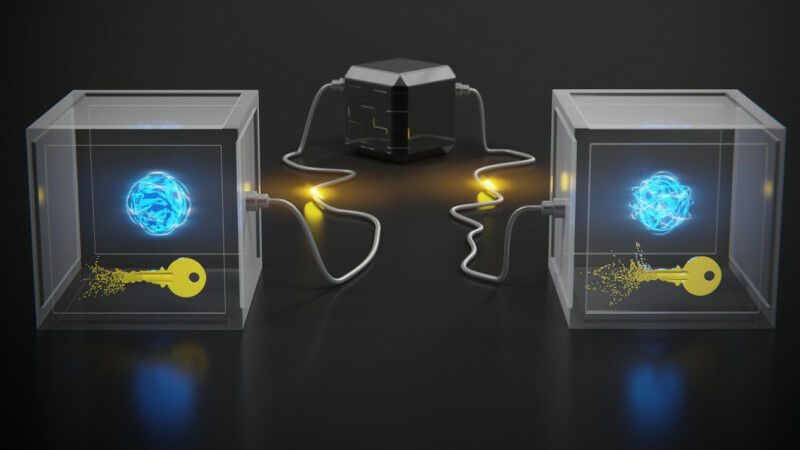
Representation Quantum Entanglement © Enrique Sahagún / EPFL 2022 - A method known as quantum key distribution has long held the promise of communication security not possible in conventional cryptography. For the first time, an international team of scientists, including researchers from EPFL, has demonstrated experimentally an approach to quantum key distribution based on high-quality quantum entanglement - offering much broader security guarantees than previous schemes. The art of cryptography is to skilfully transform messages so that they become meaningless to everyone but the intended recipients. Modern cryptographic schemes, such as those underpinning digital commerce, prevent adversaries from illegitimately deciphering messages - say, credit-card information - by requiring them to perform mathematical operations that consume a prohibitively large amount of computational power. However, for several decades now, ingenious theoretical concepts have been introduced in which security doesn't depend on an eavesdropper's finite number-crunching capabilities. Instead, the basic laws of quantum physics limit how much information, if any, an adversary can ultimately intercept. In one such concept, called quantum key distribution, security can be guaranteed with only a few general assumptions about the physical apparatus used yet practically, it has remained out of reach.
TO READ THIS ARTICLE, CREATE YOUR ACCOUNT
And extend your reading, free of charge and with no commitment.
Your Benefits
- Access to all content
- Receive newsmails for news and jobs
- Post ads