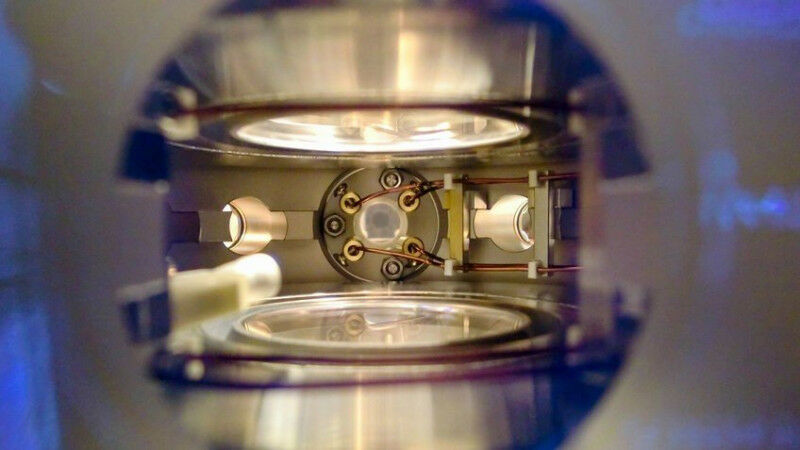
 A close view inside the main vacuum chamber of the NaK molecules experiment. In the middle four high-voltage copper wires are routed to an ultrahigh-vacuum glasscell where the ultracold polar molecules were produced.
A new method to cool gases of polar molecules to near absolute zero paves the way for studying quantum effects of exotic forms of matter. A close view inside the main vacuum chamber of the NaK molecules experiment. In the middle four high-voltage copper wires are routed to an ultrahigh-vacuum glasscell where the ultracold polar molecules were produced. MPQ - Researchers at the Max Planck Institute of Quantum Optics have developed a novel cooling technique for molecular gases. It makes it possible to cool polar molecules down to a few nanokelvin. The trick used by the team in Garching to overcome this hurdle is based on a rotating microwave field. It helps to stabilise the collisions between the molecules during cooling by means of an energetic shield.
TO READ THIS ARTICLE, CREATE YOUR ACCOUNT
And extend your reading, free of charge and with no commitment.
Your Benefits
- Access to all content
- Receive newsmails for news and jobs
- Post ads



