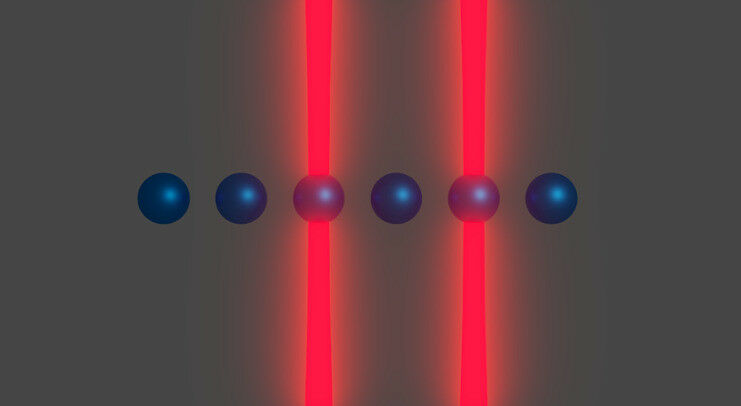
Two trapped ions (in blue) are selected by optical tweezers (in red). A quantum gate between the ions can be implemented using electric fields.
Two trapped ions ( in blue ) are selected by optical tweezers ( in red ). A quantum gate between the ions can be implemented using electric fields. Physicists from the University of Amsterdam have proposed a new architecture for a scalable quantum computer. Making use of the collective motion of the constituent particles, they were able to construct new building blocks for quantum computing that pose fewer technical difficulties than current state-of-the art methods. The results were recently published in Physical Review Letters. The researchers work at QuSoft and the Institute of Physics in the groups of Rene Gerritsma and Arghavan Safavi-Naini. The effort, which was led by the PhD candidate Matteo Mazzanti, combines two important ingredients.
TO READ THIS ARTICLE, CREATE YOUR ACCOUNT
And extend your reading, free of charge and with no commitment.