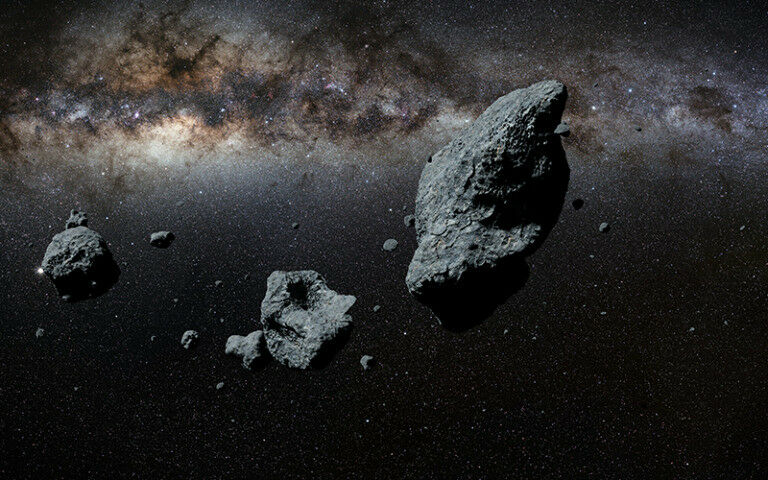
An asteroid or a meteorite flies in space, against the background of nebulae and stars
An asteroid or a meteorite flies in space, against the background of nebulae and stars Shockwaves caused by asteroids colliding with Earth create materials with a range of complex carbon structures, which could be used for advancing future engineering applications, according to an international study led by UCL and Hungarian scientists. Published today in Proceedings of the National Academy of Sciences , the team of researchers found that diamonds formed during a high-energy shock wave from an asteroid collision around 50,000 years ago have unique and exceptional properties, caused by the short-term high temperatures and extreme pressure. The researchers say that these structures can be targeted for advanced mechanical and electronic applications, giving us the ability to design materials that are not only ultra-hard but also malleable with tunable electronic properties. For the study, scientists from the UK, US, Hungary, Italy and France used detailed state-of-the-art crystallographic and spectroscopic examinations of the mineral lonsdaleite from the Canyon Diablo iron meteorite first found in 1891 in the Arizona desert. Named after the pioneering British crystallographer Professor Dame Kathleen Lonsdale, the first female professor at UCL, lonsdaleite was previously thought to consist of pure hexagonal diamond, distinguishing it from the classic cubic diamond. However, the team found that it is in fact comprised of nanostructured diamond and graphene-like intergrowths (where two minerals in a crystal grow together) called diaphites.
TO READ THIS ARTICLE, CREATE YOUR ACCOUNT
And extend your reading, free of charge and with no commitment.