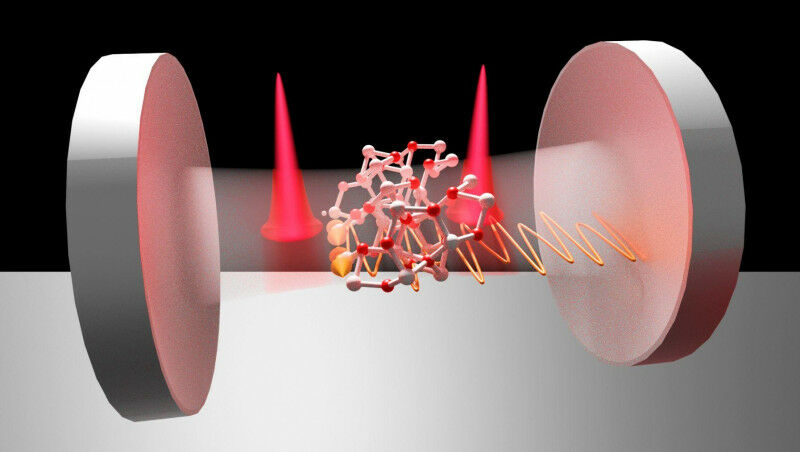
Coupling of two ultrashort solitons Image: Georg Herink.
Coupling of two ultrashort solitons Image: Georg Herink. Stable packets of light waves - called optical solitons - are emitted in ultrashort-pulse lasers as a chain of light flashes. These solitons often combine into pairs with very short temporal separation. Introducing atomic vibrations in the terahertz range, researchers at the Universities of Bayreuth and Wroclaw have now solved the puzzle of how these temporal links are formed. They report on their discovery. The dynamics of the coupled light packets can be used to measure atomic vibrations as characteristic "fingerprints" of materials in an extremely fast manner. In ultrashort-pulse lasers, optical solitons can form particularly tight spatial and temporal bonds.
TO READ THIS ARTICLE, CREATE YOUR ACCOUNT
And extend your reading, free of charge and with no commitment.