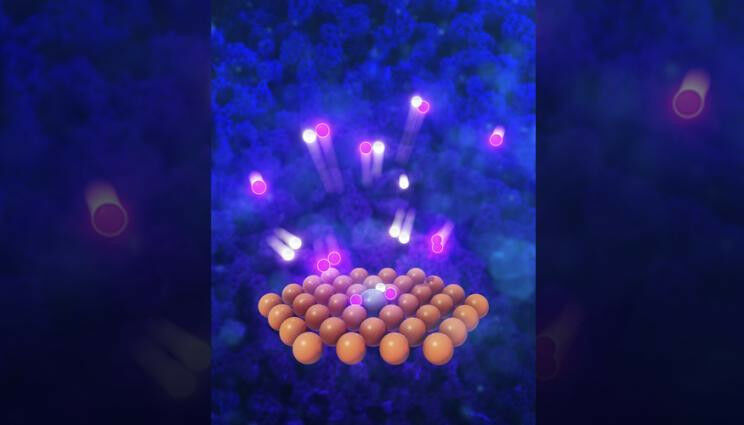
Dilute element titanium in copper matrix promotes H2-D2 exchange, which is promising for selective hydrogenation of oxygenates. Image by Ryan Chen/LLNL.
Dilute element titanium in copper matrix promotes H2-D2 exchange, which is promising for selective hydrogenation of oxygenates. Image by Ryan Chen/LLNL. Producing fragrances and flavorings and converting chemicals derived from biomass could get a boost from a new technique to break up hydrogen in nanoporous copper-titanium catalysts. The dissociation (breaking up) of hydrogen bonds is an essential elementary step in catalytic hydrogenation ( a chemical reaction between molecular hydrogen [H2] and another compound or element, usually in the presence of a catalyst ), typically requiring the use of precious metals. Lawrence Livermore National Laboratory (LLNL) scientists are mitigating the use of precious metals by diluting alloys of copper with early transition metals as selective hydrogenation catalysts, based on the principle that a more reactive metal can initiate the catalytic cycle. The research appears in the Journal of American Chemical Society . The team found that a nanoporous copper (Cu) catalysts doped with small amounts of titanium (Ti) increases the rate of hydrogen dissociation exchange by approximately one order of magnitude (5-7 times greater) compared to the undoped nanoporous Cu catalysts.
TO READ THIS ARTICLE, CREATE YOUR ACCOUNT
And extend your reading, free of charge and with no commitment.