Image: Aya Tsuboi, Kavli Institute for the Physics and Mathematics of the Universe
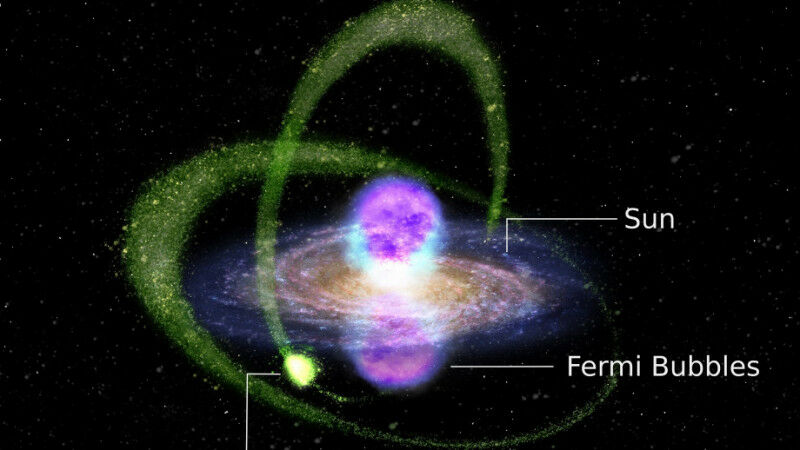
Image: Aya Tsuboi, Kavli Institute for the Physics and Mathematics of the Universe - A study by an international team of scientists has shed new light on the origins of a bright patch of gamma radiation toward the centre of our Milky Way. The findings revealed the gamma-ray signal is actually coming from rapidly spinning stars belonging to a neighbouring galaxy, rather than being an indicator of dark matter. The study focused on the so-called Fermi bubbles, two globe-shaped structures spanning a whopping 50,000 light-years that were initially discovered in 2010 thanks to data collected by the Fermi Gamma-ray Space Telescope. Co-author of the study, Associate Professor Roland Crocker from The Australian National University (ANU) said that within these mysterious Fermi bubbles, there are regions which are particularly bright. "One of the brightest spots, the Fermi cocoon, is found in the southern bubble," Associate Professor Crocker said. "This particularly bright patch was originally thought to be the result of a past outburst from the Galaxy's supermassive black hole, but our study shows it's actually coming from the Sagittarius dwarf galaxy. "This is a galaxy that actually orbits the Milky Way and which, by chance, we view through the Fermi Bubbles from the Earth's position.
TO READ THIS ARTICLE, CREATE YOUR ACCOUNT
And extend your reading, free of charge and with no commitment.