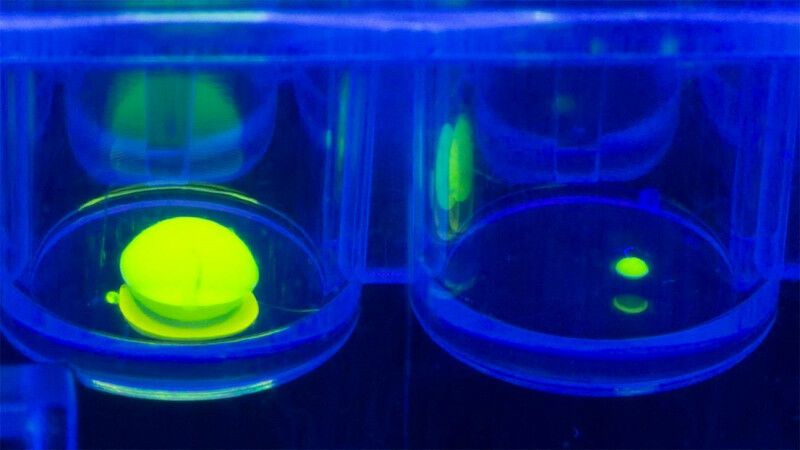
An 80 nanoliter reaction volume inside a well of a microwell plate (around 1 mm diameter), like the ones used in high-throughput screening. Credit: Mischa Schüttel (EPFL)
An 80 nanoliter reaction volume inside a well of a microwell plate (around 1 mm diameter), like the ones used in high-throughput screening. Credit: Mischa Schüttel (EPFL) - Scientists at EPFL have found a way to synthesize large numbers of macrocyclic compounds, which are needed for developing drugs against difficult disease targets. When pharmaceutical companies begin looking for a drug candidate, they use a filtering process known as "high-throughput screening". Here, large numbers of different chemical compounds are tested to see which will bind to a protein that is the target of the disease they want to address. Pharmaceutical companies actually have libraries of 1-2 million "small-molecule" compounds collected over years. But in many cases, screening classical small-molecule compounds can't identify drug candidates simply because they don't contain a compound that binds sufficiently strong to the target. A solution has been found in the "macrocycles", an emerging class of molecules that have proven to be ideal for binding difficult targets like proteins with flat surfaces or even proteins bound to other proteins.
TO READ THIS ARTICLE, CREATE YOUR ACCOUNT
And extend your reading, free of charge and with no commitment.