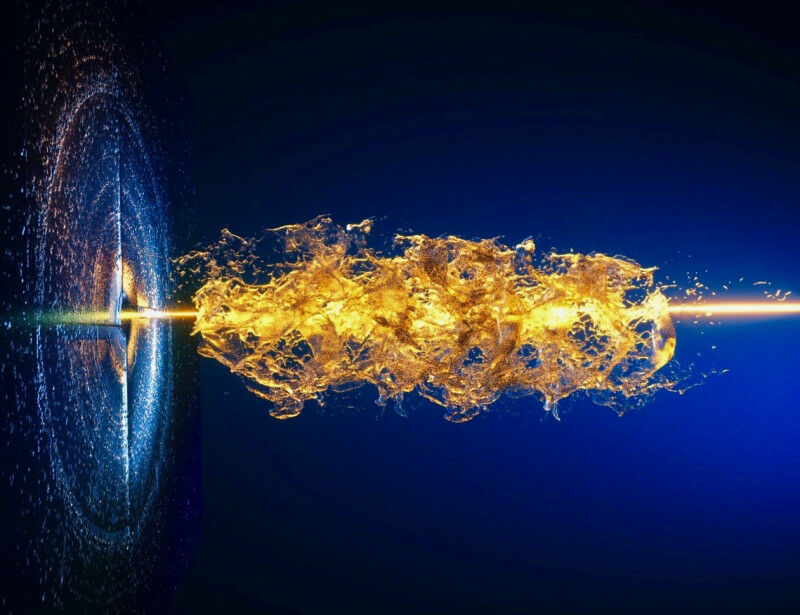
An illustration of the serial femtosecond X-ray crystallography process, showing a jet of liquid solvent combined with the sample particles being blasted with the laser beam to capture diffraction data. This action is completed in just a few femtoseconds - that is quadrillionths of a second, or a few millionths of one billionth of a second. (Credit: Ella Maru Studio)
An illustration of the serial femtosecond X-ray crystallography process, showing a jet of liquid solvent combined with the sample particles being blasted with the laser beam to capture diffraction data. This action is completed in just a few femtoseconds - that is quadrillionths of a second, or a few millionths of one billionth of a second. (Credit: Ella Maru Studio) - Advanced algorithms plus an exceptional X-ray laser can reveal the structures of not-so-neat-and-tidy materials unattainable by other techniques Francis Crick, who famously co-discovered the shape of DNA , once said: "If you want to understand function, study structure." Many decades later, this remains a tenet of biology, chemistry, and materials science. A key breakthrough in the quest for DNA's structure came from X-ray crystallography, a technique that maps the density of electrons in a molecule based on how beams of X-ray radiation diffract through the spaces between atoms in the sample. The diffraction patterns generated by crystallography can then be used to deduce the overall molecular structure. Thanks to a steady stream of advances over the decades, X-ray crystallography is now exponentially more powerful than it was in Crick's time, and can even reveal the placement of individual atoms. Yet the process is not easy.
TO READ THIS ARTICLE, CREATE YOUR ACCOUNT
And extend your reading, free of charge and with no commitment.