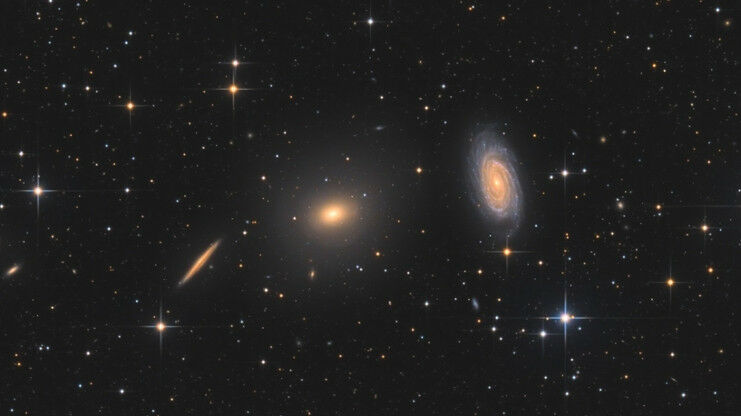
In the centre of the image the elliptical galaxy NGC5982, and to the right the spiral galaxy NGC5985. These two types of galaxies turn out to behave very differently when it comes to the extra gravity - and therefore possibly the dark matter - in their outer regions. Images: Bart Delsaert (www.delsaert.com).
In the centre of the image the elliptical galaxy NGC5982, and to the right the spiral galaxy NGC5985. These two types of galaxies turn out to behave very differently when it comes to the extra gravity - and therefore possibly the dark matter - in their outer regions. Images: Bart Delsaert (www.delsaert.com). For many years now, astronomers and physicists have been in a conflict. Is the mysterious dark matter that we observe deep in the Universe real, or is what we see the result of subtle deviations from the laws of gravity as we know them? In 2016, Dutch physicist Erik Verlinde proposed a theory of the second kind: emergent gravity. New research, published in Astronomy & Astrophysics this week, pushes the limits of dark matter observations to the unknown outer regions of galaxies, and in doing so re-evaluates several dark matter models and alternative theories of gravity. Measurements of the gravity of 259,000 isolated galaxies show a very close relation between the contributions of dark matter and those of ordinary matter, as predicted in Verlinde's theory of emergent gravity and an alternative model called Modified Newtonian Dynamics.
TO READ THIS ARTICLE, CREATE YOUR ACCOUNT
And extend your reading, free of charge and with no commitment.