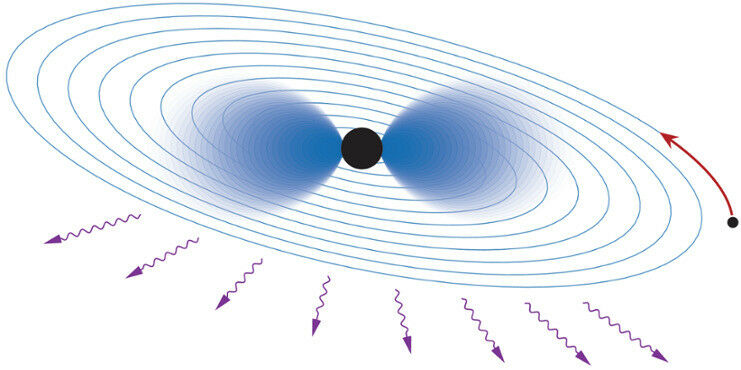
An atom in the sky. If new ultralight particles exist, black holes would be surrounded by a cloud of such particles that behaves surprisingly similar to the cloud of electrons in an atom. When another heavy object spirals in and eventually merges with the black hole, the gravitational atom gets ionized and emits particles just like electrons are emitted when light is shone onto a metal.
An atom in the sky. If new ultralight particles exist, black holes would be surrounded by a cloud of such particles that behaves surprisingly similar to the cloud of electrons in an atom. When another heavy object spirals in and eventually merges with the black hole, the gravitational atom gets ionized and emits particles just like electrons are emitted when light is shone onto a metal. Clouds of ultralight particles can form around rotating black holes. A team of physicists from the University of Amsterdam and Harvard University now show that these clouds would leave a characteristic imprint on the gravitational waves emitted by binary black holes. Black holes are generally thought to swallow all forms of matter and energy surrounding them. It has long been known, however, that they can also shed some of their mass through a process called superradiance .
TO READ THIS ARTICLE, CREATE YOUR ACCOUNT
And extend your reading, free of charge and with no commitment.