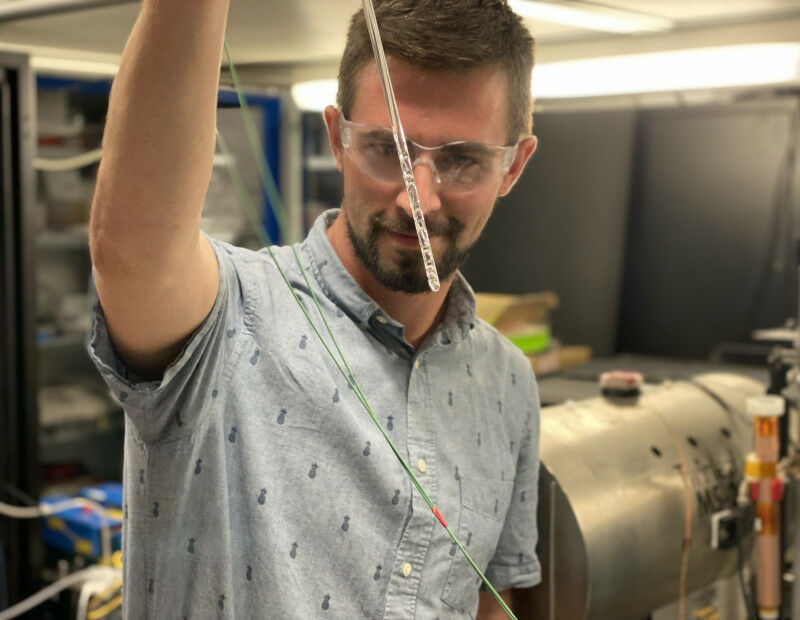
Dr. Danila Barskiy conducting an experiment
New method for the detection of alcohols combines zeroto ultralow-field nuclear magnetic resonance with the SABRE-Relay hyperpolarization technique. Dr. Danila Barskiy conducting an experiment - Nuclear magnetic resonance (NMR) is an analytical tool with a wide range of applications, including the magnetic resonance imaging that is used for diagnostic purposes in medicine. However, NMR often requires powerful magnetic fields to be generated, which limits the scope of its use. Researchers working at Johannes Gutenberg University Mainz (JGU) and the Helmholtz Institute Mainz (HIM) have now discovered potential new ways to reduce the size of the corresponding devices and also the possible associated risk by eliminating the need for strong magnetic fields. This is achieved by combining so-called zeroto ultralow-field NMR with a special hyperpolarization technique. "This exciting new method is based on an innovative concept. It opens up a whole range of opportunities and overcomes previous disadvantages," said Dr. Danila Barskiy, a Sofja Kovalevskaja Award winner who has been working in the relevant discipline at JGU and HIM since 2020.
TO READ THIS ARTICLE, CREATE YOUR ACCOUNT
And extend your reading, free of charge and with no commitment.