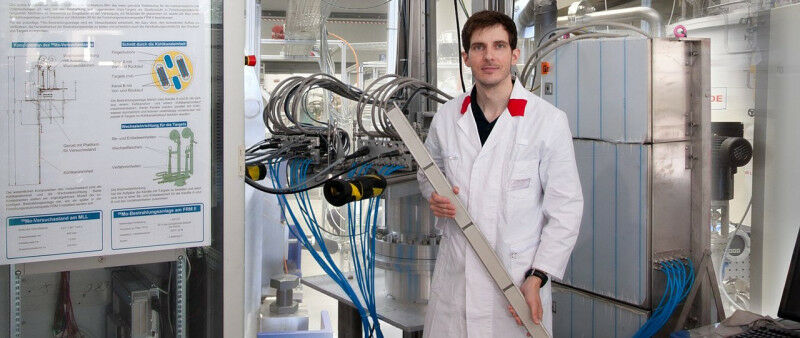
Tobias Chemnitz at the test facility for Mo-99 production at FRM II at the Garching reserach campus. Image: Reiner Müller, FRM II / TUM
Tobias Chemnitz at the test facility for Mo-99 production at FRM II at the Garching reserach campus. Image: Reiner Müller, FRM II / TUM New separation process for key radiodiagnostic agent reduces radioactive waste - Nuclear medicine uses technetium-99m among other things for tumor diagnostics. With over 30 million applications worldwide each year, it is the most widely used radioisotope. The precursor material, molybdenum-99, is mainly produced in research reactors. A study at the Heinz Maier-Leibnitz Research Neutron Source (FRM II) at the Technical University of Munich (TUM) now shows options to significantly reduce the radioactive waste produced during processing to a medical product. Over 85 percent of all nuclear medicine diagnostic examinations use technetium-99m (Tc-99m). In Germany alone, more than 3 million doses are deployed every year.
TO READ THIS ARTICLE, CREATE YOUR ACCOUNT
And extend your reading, free of charge and with no commitment.