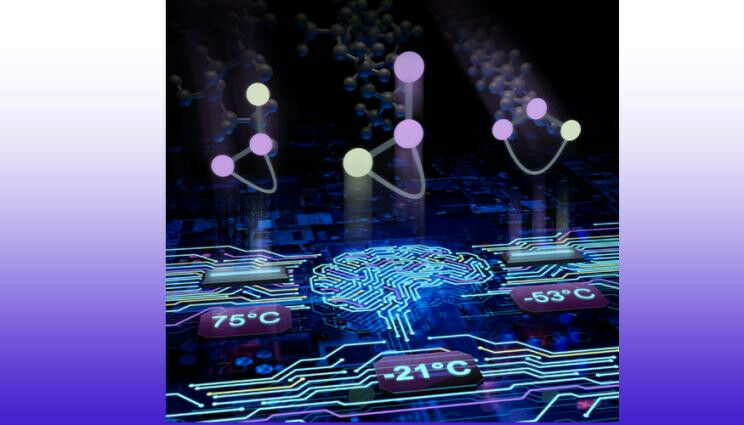
An artist’s rendering shows how polymers can be represented as graphs for the machine-learning model and how subtle changes in polymers’ connectivity and periodicity can have dramatic effects on their predicted properties; in this case, glass-transition temperature. Image by Eric Smith/LLNL.
An artist's rendering shows how polymers can be represented as graphs for the machine-learning model and how subtle changes in polymers' connectivity and periodicity can have dramatic effects on their predicted properties; in this case, glass-transition temperature. Image by Eric Smith/LLNL. Hundreds of millions of tons of polymer materials are produced globally for use in a vast and ever-growing application space with new material demands such as green chemistry polymers, consumer packaging, adhesives, automotive components, fabrics and solar cells. But discovering suitable polymer materials for use in these applications lies in accurately predicting the properties that a candidate material will have. Obtaining a quantitative understanding of the relationship between chemical structure and observable properties is particularly challenging for polymers, due to their complex 3D chemical assembly that can consist of extremely long chains of thousands of atoms. Recently, a team of Lawrence Livermore National Laboratory (LLNL) materials and computer scientists tackled this challenge with a data-driven approach. By using datasets of polymer properties, the researchers developed a novel machine-learning (ML) model that can predict 10 distinct polymer properties more accurately than was possible with previous ML models.
TO READ THIS ARTICLE, CREATE YOUR ACCOUNT
And extend your reading, free of charge and with no commitment.