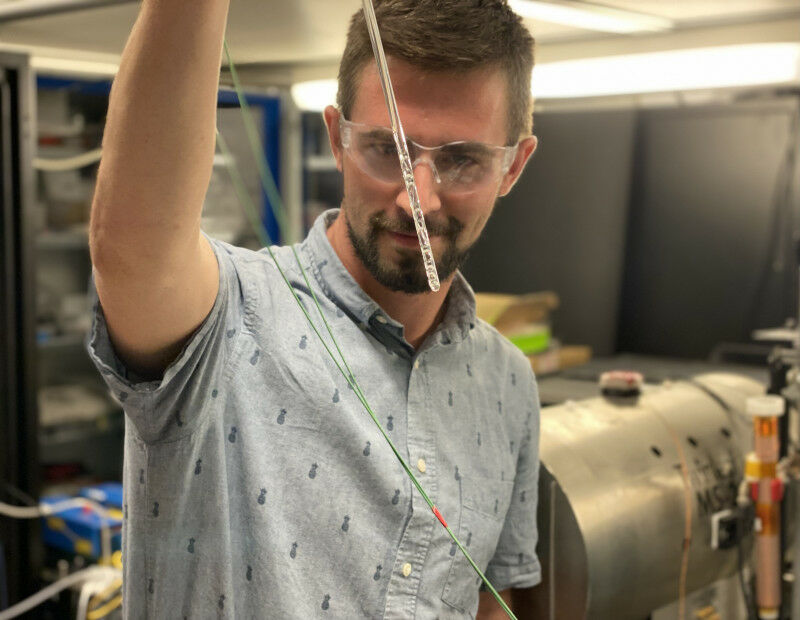
Danila Barskiy at the experiment
New approach combines zero-to-ultra-low field magnetic resonance with hyperpolarization technique SABRE-Relay to study alcohols. Danila Barskiy at the experiment - Nuclear magnetic resonance provides the basis for numerous applications, such as magnetic resonance imaging in medical diagnostics. However, strong magnetic fields are still required, which limits the use of Nuclear Magnetic Resonance (NMR). Research at the Johannes Gutenberg University Mainz (JGU) and the Helmholtz Institute Mainz (HIM) is now showing new possibilities that can contribute to a reduction in the size of the devices and greater safety because they dispense with strong magnetic fields. This is achieved by combining zero-to-ultra-low field magnetic resonance with a special technique for hyperpolarization. "It's a conceptually new, beautiful method that opens up a lot of opportunities for us and overcomes the previous drawbacks," says Danila Barskiy, a Sofja Kovalevskaja Award winner who has been working in this field at JGU and HIM since 2020. New approach should enable measurements without strong magnetic fields.
TO READ THIS ARTICLE, CREATE YOUR ACCOUNT
And extend your reading, free of charge and with no commitment.