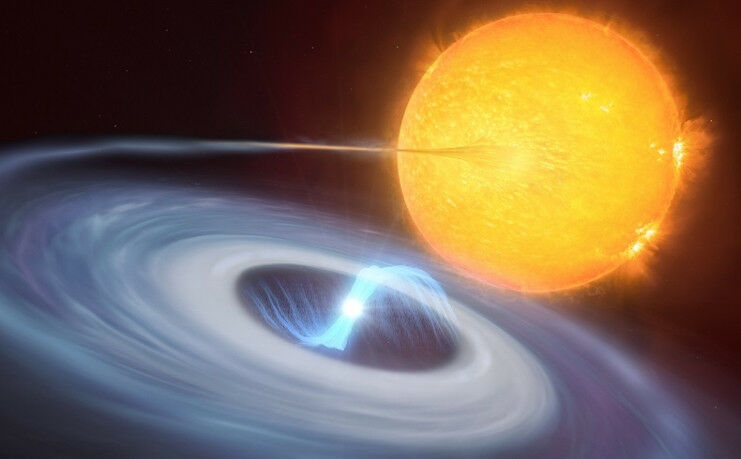
This artist’s impression shows a two-star system where micronovae may occur. The blue disc swirling around the bright white dwarf in the centre of the image is made up of material, mostly hydrogen, stolen from its companion star. Towards the centre of the disc, the white dwarf uses its strong magnetic fields to funnel the hydrogen towards its poles. As the material falls on the hot surface of the star, it triggers a micronova explosion, contained by the magnetic fields at one of the white dwarf’s poles.
This artist's impression shows a two-star system where micronovae may occur. The blue disc swirling around the bright white dwarf in the centre of the image is made up of material, mostly hydrogen, stolen from its companion star. Towards the centre of the disc, the white dwarf uses its strong magnetic fields to funnel the hydrogen towards its poles. As the material falls on the hot surface of the star, it triggers a micronova explosion, contained by the magnetic fields at one of the white dwarf's poles. A team of astronomers, including the UvA's Nathalie Degenaar have observed a new type of stellar explosion - a micronova, with the help of the European Southern Observatory's Very Large Telescope (ESO's VLT). These outbursts happen on the surface of certain stars, and can each burn through around 3.5 billion Great Pyramids of Giza of stellar material in only a few hours. 'We have discovered and identified for the first time what we are calling a micronova,' explains Simone Scaringi, an astronomer at Durham University in the UK who led 'The phenomenon challenges our understanding of how thermonuclear explosions in stars occur.
TO READ THIS ARTICLE, CREATE YOUR ACCOUNT
And extend your reading, free of charge and with no commitment.