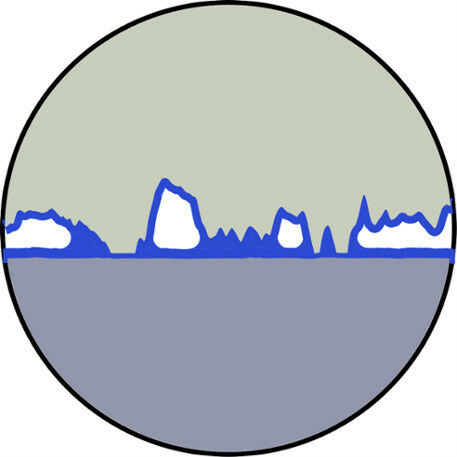
A rough surface (light grey) pressed on a very smooth surface (dark grey) with only a few points of real contact. Due to humidity, both surfaces are covered with a thin water film (blue). In the areas where the surfaces nearly touch the roughness size is in the order of magnitude of the water film thickness and capillary adhesion increases the friction between the surfaces.
A rough surface (light grey) pressed on a very smooth surface (dark grey) with only a few points of real contact. Due to humidity, both surfaces are covered with a thin water film ( blue ). In the areas where the surfaces nearly touch the roughness size is in the order of magnitude of the water film thickness and capillary adhesion increases the friction between the surfaces. Understanding roughness and friction at the nanoscale 9 February 2022 The amount of friction between surfaces generally depends on their roughness, but at the nanoscale 'rough' surfaces experience less friction than smoother surfaces. With a unique experimental setup, researchers at ARCNL and the University of Amsterdam were able to image surface roughness with nanoscale accuracy and relate these measurements to friction experiments that confirm this counter-intuitive fact, which is caused by capillary effects. Their results lead to a predictive understanding of contact mechanics and friction that is relevant to applications like precision positioning in the lithography industry. Last month, scientific journal Physical Review Research published their findings.
TO READ THIS ARTICLE, CREATE YOUR ACCOUNT
And extend your reading, free of charge and with no commitment.