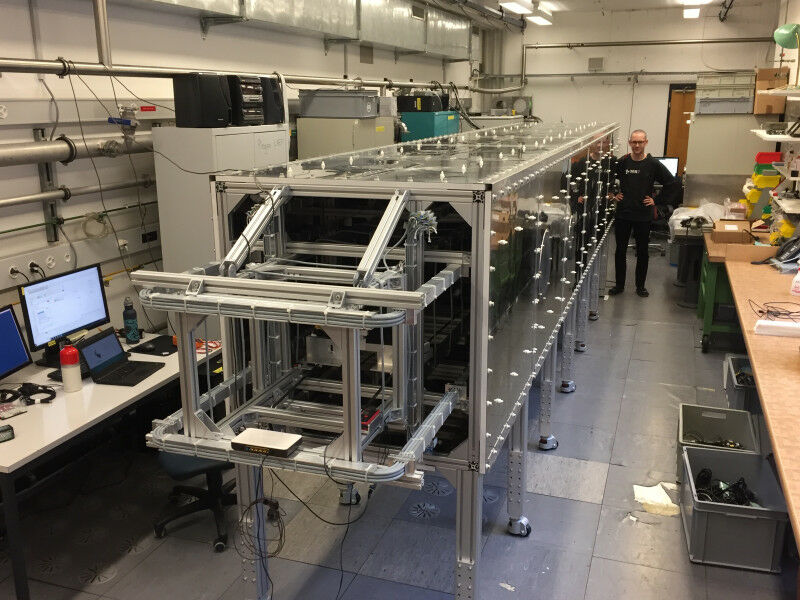
Part of the experimental apparatus in the laboratory in Bern with PhD candidate Ivo Schulthess. @ Courtesy of F. Piegsa
Part of the experimental apparatus in the laboratory in Bern with PhD candidate Ivo Schulthess. Courtesy of F. Piegsa - With the use of a precision experiment developed at the University of Bern, an international research team has succeeded in significantly narrowing the scope for the existence of dark matter. The experiment was carried out at the European Research Neutron Source at the Institute Laue-Langevin in France, and makes an important contribution to the search for these particles, of which little remains known. Cosmological observations of the orbits of stars and galaxies enable clear conclusions to be drawn about the attractive gravitational forces that act between the celestial bodies. The astonishing finding: visible matter is far from sufficient for being able to explain the development or movements of galaxies. This suggests that there exists another, so far unknown, type of matter. Accordingly, in the year 1933, the Swiss physicist and astronomer Fritz Zwicky inferred the existence of what is known now as dark matter.
TO READ THIS ARTICLE, CREATE YOUR ACCOUNT
And extend your reading, free of charge and with no commitment.