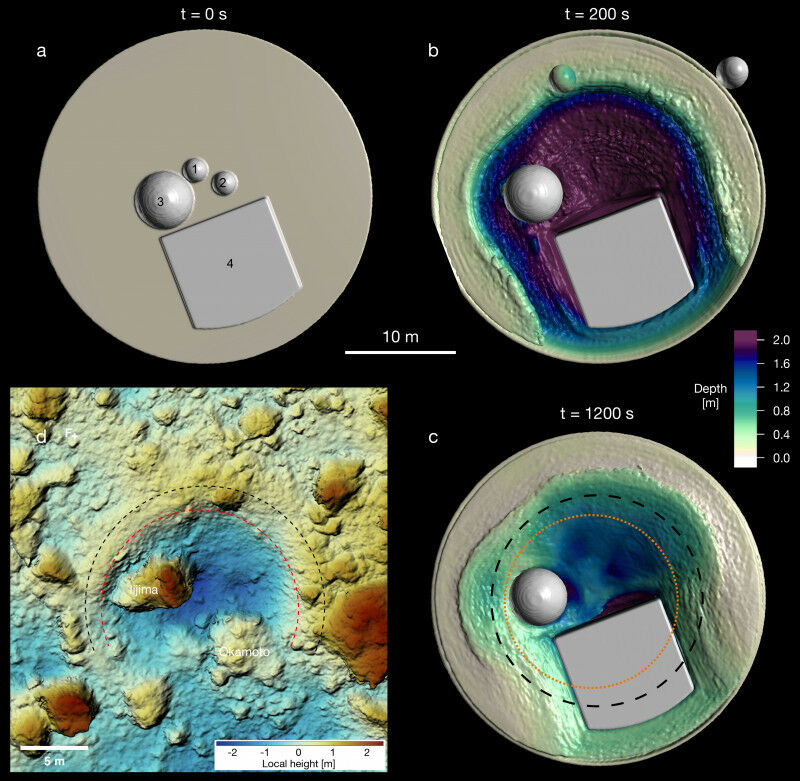
Simulation of the SCI impact. a) - c) Snapshots of the simulation at different times. At t = 1200s, the development of the crater is over. d) SCI crater on the asteroid Ryugu. The key characteristics of the observed crater, including the displacement of the boulders, are recreated in the simulation. @ Courtesy of Martin Jutzi
Simulation of the SCI impact. a) - c) Snapshots of the simulation at different times. At t = 1200s, the development of the crater is over. d) SCI crater on the asteroid Ryugu. The key characteristics of the observed crater, including the displacement of the boulders, are recreated in the simulation. Courtesy of Martin Jutzi - The impact experiment conducted on the asteroid Ryugu by the Japanese Hayabusa2 mission which took place two years ago resulted in an unexpectedly large crater. With the use of simulations, a team led by the University of Bern and the National Center of Competence in Research (NCCR) PlanetS has recently succeeded in gaining new insights from the experiment regarding the formation and development of asteroids.
TO READ THIS ARTICLE, CREATE YOUR ACCOUNT
And extend your reading, free of charge and with no commitment.