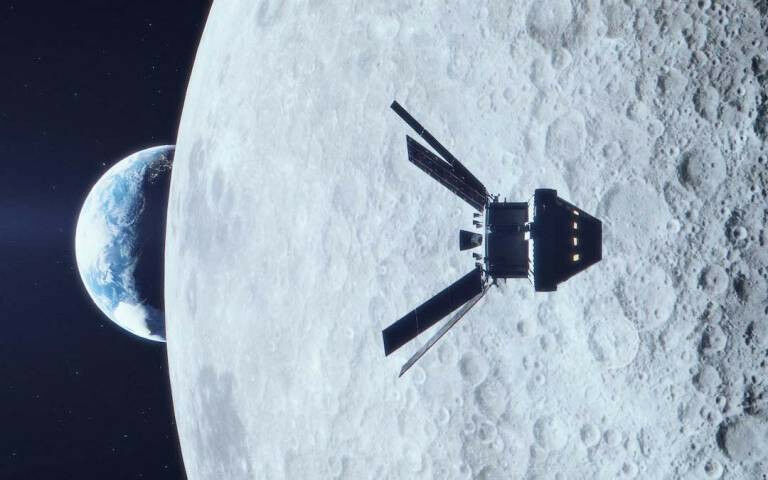
Artist's impression of the Artemis Orion capsule flying close to the moon
Artist's impression of the Artemis Orion capsule flying close to the moon UCL researchers are helping NASA prepare for its Artemis programme moon missions by creating high-resolution 3D models of potential landing sites. The first phase of NASA's Artemis mission, an uncrewed test flight around the moon, was scheduled to launch this Monday (29 August 2022). The third phase, scheduled for 2025, will see humans land on the moon for the first time in more than 50 years. Professor Jan-Peter Muller and PhD candidate Alfiah Putri (both UCL Mullard Space Science Laboratory) were commissioned by NASA's Jet Propulsion Laboratory (JPL) to create a 3D model and image of a possible landing site known as Aristarchus - a crater 40km wide and nearly 2.7km deep that was originally selected as the landing site for the cancelled Apollo 18 mission. The team used a photogrammetry technique they pioneered to derive a detailed 3D model, at a resolution of one metre, from a series of 14 stereo images (where pictures are taken of the same scene at slightly different angles). Professor Muller said: "Better quality maps and models of the moon's surface are important to minimise risks and maximise the safety of astronauts. Our techniques, developed over decades, provide the most accurate images and models currently possible.
TO READ THIS ARTICLE, CREATE YOUR ACCOUNT
And extend your reading, free of charge and with no commitment.