Tiny hairs on the outer wall of some cells can move in different directions, thereby influencing each other
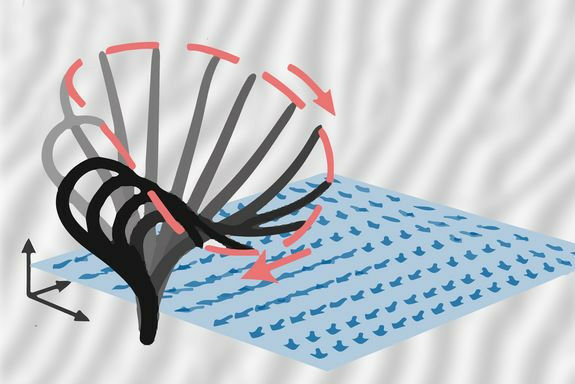
Tiny hairs on the outer wall of some cells can move in different directions, thereby influencing each other Tiny hairs on cell walls, so-called -cilia-, can move in unison to pump fluid. Now there finally is a physical theory describing these hairs' movements. They are only very simple structures, but without them we could not survive: Countless tiny hairs (cilia) are found on the outer wall of some cells, for example in our lungs or in our brain. When these micrometre-sized hairs coordinate their movement and produce wave-like movements together, they can cause currents on a microscale and thus pump fluid from one place to another. Paramecia - unicellular organisms with numerous cilia - also use such effects to move around. How the synchronisation of such micro-hairs comes about and what effects it has - such questions have so far only been studied in large computer simulations. However, more than a few thousand hairs cannot be simulated in this way.
TO READ THIS ARTICLE, CREATE YOUR ACCOUNT
And extend your reading, free of charge and with no commitment.