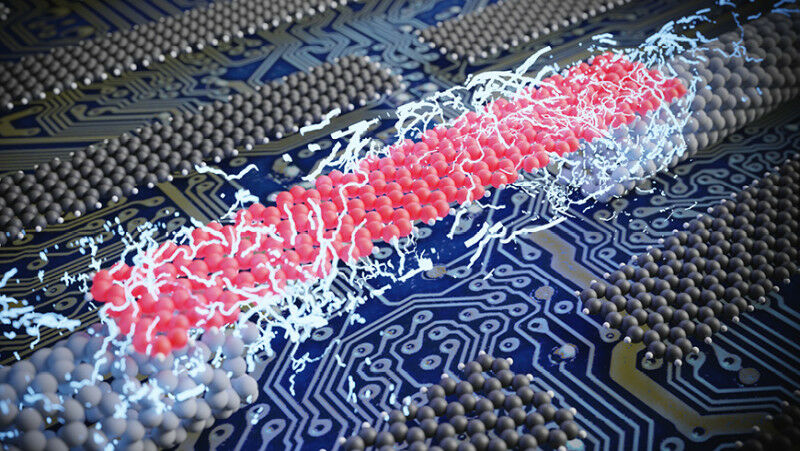
Researchers and their international collaborators have successfully attached carbon nanotube electrodes to individual atomically precise nanoribbons. Image: Empa
Researchers and their international collaborators have successfully attached carbon nanotube electrodes to individual atomically precise nanoribbons. Image: Empa Quantum technology is promising, but also perplexing. In the coming decades, it is expected to provide us with various technological breakthroughs: smaller and more precise sensors, highly secure communication networks, and powerful computers that can help develop new drugs and materials, control financial markets, and predict the weather much faster than current computing technology ever could. To achieve this, we need so-called quantum materials: substances that exhibit pronounced quantum physical effects. One such material is graphene. This two-dimensional structural form of carbon has unusual physical properties, such as extraordinarily high tensile strength, thermal and electrical conductivity - as well as certain quantum effects. Restricting the already two-dimensional material even further, for instance, by giving it a ribbon-like shape, gives rise to a range of controllable quantum effects.
TO READ THIS ARTICLE, CREATE YOUR ACCOUNT
And extend your reading, free of charge and with no commitment.