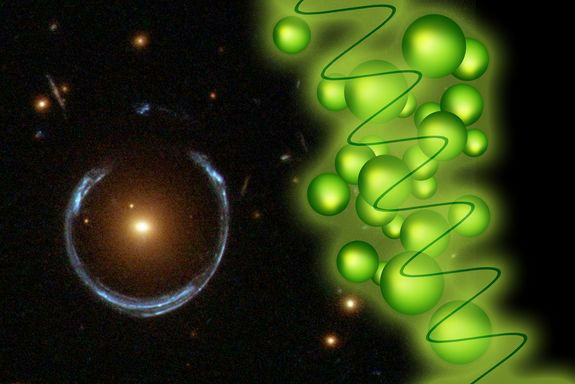
© NASA / TU Wien New techniques can answer questions that were previously inaccessible experimentally - including questions about the relationship between quantum mechanics and relativity. The theory of relativity works well when you want to explain cosmic-scale phenomena - such as the gravitational waves created when black holes collide. Quantum theory works well when describing particle-scale phenomena - such as the behavior of individual electrons in an atom. But combining the two in a completely satisfactory way has yet to be achieved. The search for a "quantum theory of gravity" is considered one of the significant unsolved tasks of science. This is partly because the mathematics in this field is highly complicated. At the same time, it is tough to perform suitable experiments: One would have to create situations in which phenomena of both the relativity theory play an important role, for example, a spacetime curved by heavy masses, and at the same time, quantum effects become visible, for example the dual particle and wave nature of light.
TO READ THIS ARTICLE, CREATE YOUR ACCOUNT
And extend your reading, free of charge and with no commitment.
Your Benefits
- Access to all content
- Receive newsmails for news and jobs
- Post ads