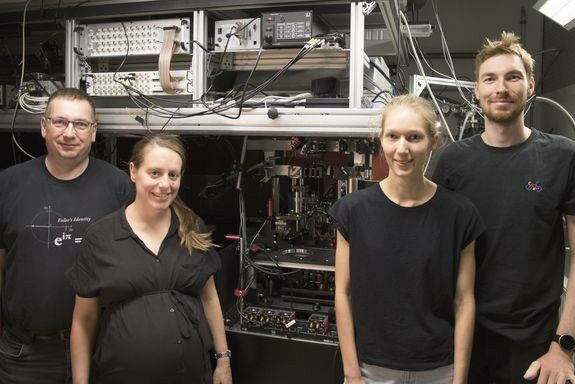
Helmut Hörner, Sarah M. Skoff, Ambika Shorny, Fritz Steiner (from left)
Helmut Hörner, Sarah M. Skoff, Ambika Shorny, Fritz Steiner ( from left ) Tiny plastic particles are an environmental problem. They can even penetrate living cells. A method has now been developed at TU Wien to detect such particles quickly and with high sensitivity. It is well known that microplastics are a problem: They are tiny, barely visible plastic particles that can harm the environment, for example, if they are eaten by animals. However, it has been difficult to assess the effect of even smaller particles, which can hardly be detected using conventional methods: Plastic particles with a diameter of less than one micrometer commonly referred to as "nanoplastics". Such tiny particles can even be absorbed into living cells. TU Wien (Vienna) has now succeeded in developing a measurement method which can even detect individual nanoplastic particles - orders of magnitude faster than previous techniques.
TO READ THIS ARTICLE, CREATE YOUR ACCOUNT
And extend your reading, free of charge and with no commitment.