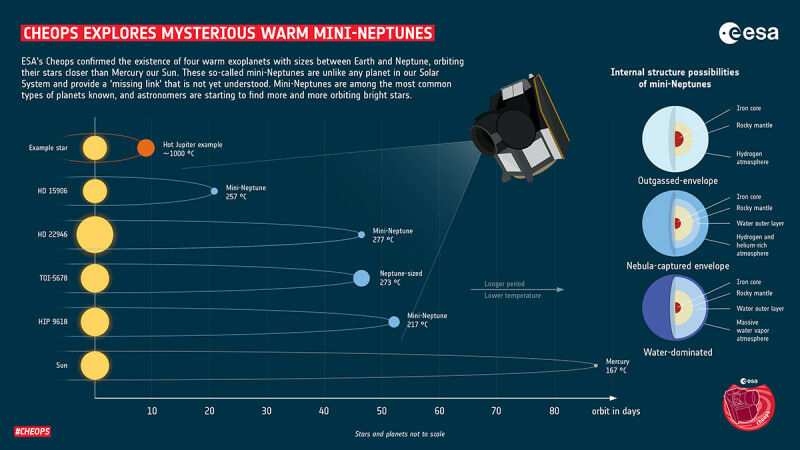
 Cheops confirmed the existence of four warm exoplanets with sizes between Earth and Neptune, orbiting their stars closer than Mercury our Sun. These so-called mini- Neptunes are unlike any planet in our Solar System and provide a ’missing link’ that is not yet understood. Mini-Neptunes are among the most common types of planets known, and astronomers are starting to find more and more orbiting bright stars
Cheops confirmed the existence of four warm exoplanets with sizes between Earth and Neptune, orbiting their stars closer than Mercury our Sun. These so-called mini- Neptunes are unlike any planet in our Solar System and provide a 'missing link' that is not yet understood. Mini-Neptunes are among the most common types of planets known, and astronomers are starting to find more and more orbiting bright stars © ESA - With the help of the CHEOPS space telescope an international team of European astronomers managed to clearly identify the existence of four new exoplanets. The four mini-Neptunes are smaller and cooler, and more difficult to find than the so-called Hot Jupiter exoplanets which have been found in abundance. Two of the four resulting papers are led by researchers from the University of Bern and the University of Geneva who are also members of the National Centre of Competence in Research (NCCR) PlanetS. CHEOPS is a joint mission by the European Space Agency (ESA) and Switzerland, under the leadership of the University of Bern in collaboration with the University of Geneva. Since its launch in December 2019, the extremely precise measurements of CHEOPS have contributed to several key discoveries in the field of exoplanets.
TO READ THIS ARTICLE, CREATE YOUR ACCOUNT
And extend your reading, free of charge and with no commitment.
Your Benefits
- Access to all content
- Receive newsmails for news and jobs
- Post ads