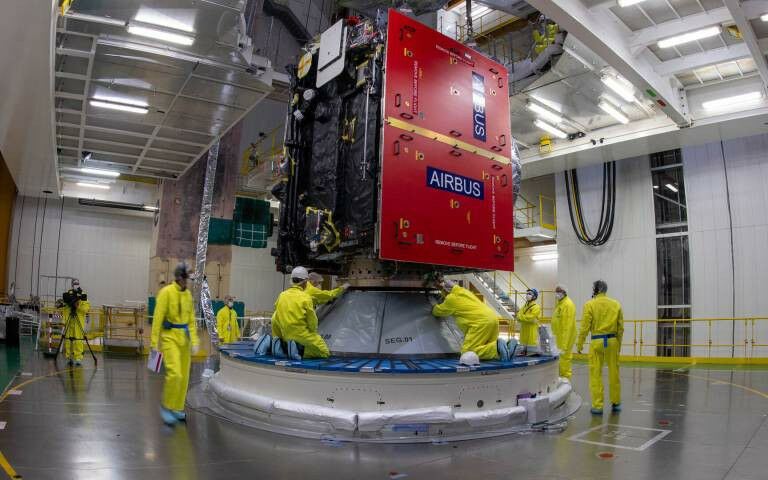
JUICE meets Ariane: ESA’s Jupiter Icy Moons Explorer (JUICE) on top of the Ariane 5 rocket that will carry it into space. Technicians are working atop the rocket, bolting down Juice’s launch vehicle adapter to keep it secure during launch.
JUICE meets Ariane: ESA's Jupiter Icy Moons Explorer (JUICE) on top of the Ariane 5 rocket that will carry it into space. Technicians are working atop the rocket, bolting down Juice's launch vehicle adapter to keep it secure during launch. A Jupiter-exploring mission, which includes hardware provided by UCL scientists, is due to take off tomorrow (Thursday 13 April)m and will investigate whether some of the planet's icy moons are home to conditions that could support life. The European Space Agency's Jupiter Icy Moons Explorer (JUICE) will spend eight years travelling to the Jupiter system. On the way, it will perform fly-bys of Earth and Venus, using the gravitationalm fields of the planets to generate enough speed to reach Jupiter. One of these will be the first ever lunar-Earth gravity assist manoeuvre. UCL researchers, funded by the UK Space Agency, provided particle detectors for the spacecraft's Particle Environment Package (PEP), which will sample the particles whizzing around Jupiter, including, potentially, from plumes of water spraying up from the moon Europa.
TO READ THIS ARTICLE, CREATE YOUR ACCOUNT
And extend your reading, free of charge and with no commitment.