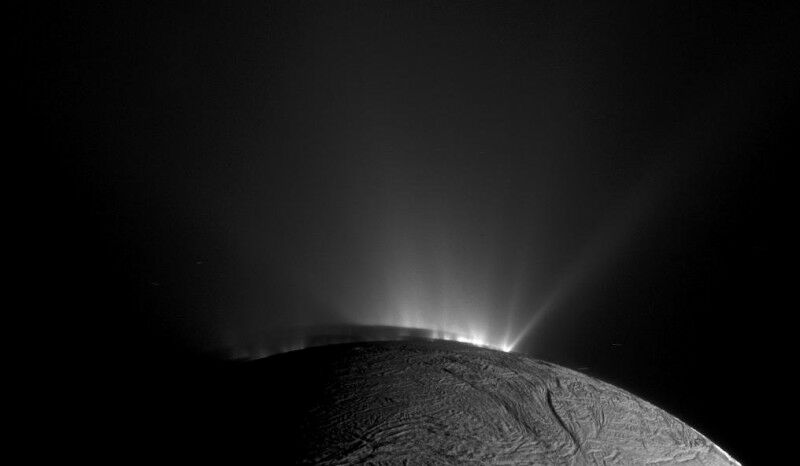
Water from the subsurface ocean of Saturn’s moon Enceladus sprays from huge fissures out into space. NASA’s Cassini spacecraft, which captured this image in 2010, sampled icy particles and scientists are continuing to make new discoveries from the data.
Water from the subsurface ocean of Saturn's moon Enceladus sprays from huge fissures out into space. NASA's Cassini spacecraft, which captured this image in 2010, sampled icy particles and scientists are continuing to make new discoveries from the data. Water from the subsurface ocean of Saturn's moon Enceladus sprays from huge fissures out into space. NASA's Cassini spacecraft, which captured this image in 2010, sampled icy particles and scientists are continuing to make new discoveries from the dat. Credit: NASA/JPL-Caltech/Space Science Institute" A study zooms in on data that NASA's Cassini gathered at Saturn's icy moon and finds evidence of a key ingredient for life and a supercharged source of energy to fuel it. Scientists have known that the giant plume of ice grains and water vapor spewing from Saturn's moon Enceladus is rich with organic compounds, some of which are important for life as we know it. Now, scientists analyzing data from NASA's Cassini mission are taking the evidence for habitability a step further: They've found strong confirmation of hydrogen cyanide, a molecule that is key to the origin of life.
TO READ THIS ARTICLE, CREATE YOUR ACCOUNT
And extend your reading, free of charge and with no commitment.