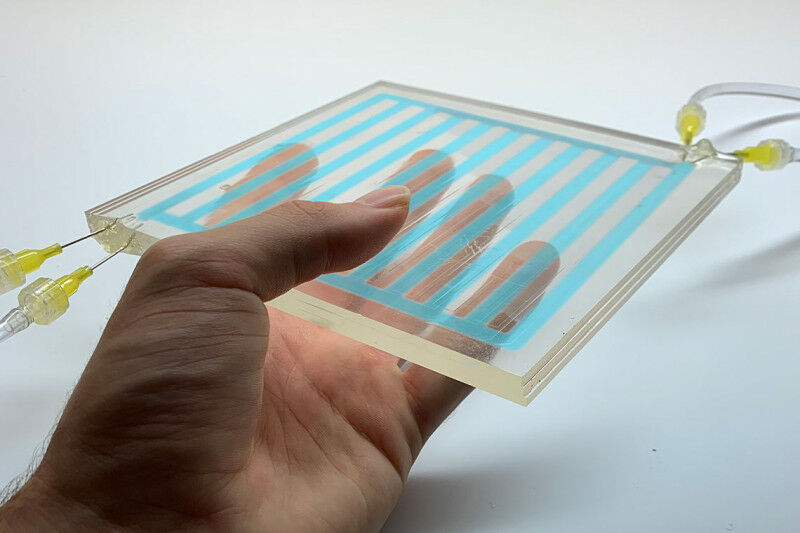
Prototypes of a multilayered fluidic system designed by U of T Engineering researchers contain several layers of channels that contain fluids with various optical properties (artist’s impression courtesy of Raphael Kay, Adrian So)
Prototypes of a multilayered fluidic system designed by U of T Engineering researchers contain several layers of channels that contain fluids with various optical properties (artist's impression courtesy of Raphael Kay, Adrian So) Inspired by the dynamic colour-changing skin of organisms such as squid, University of Toronto researchers have developed a multilayered fluidic system that can reduce the energy costs of heating, cooling and lighting buildings. The platform, which optimizes the wavelength, intensity and dispersion of light transmitted through windows, offers much greater control than existing technologies while keeping costs low due to its use of simple, off-the-shelf components. "Buildings use a ton of energy to heat, cool and illuminate the spaces inside them," says Raphael Kay , who recently graduated with a master's degree in mechanical engineering from the Faculty of Applied Science & Engineering and is lead author on a new paper published in the journal PNAS. "If we can strategically control the amount, type and direction of solar energy that enters our buildings, we can massively reduce the amount of work that we ask heaters, coolers and lights to do." Currently, certain "smart" building technologies such as automatic blinds or electrochromic windows - which change their opacity in response to an electric current - can be used to control the amount of sunlight that enters the room. But Kay says that these systems are limited: they cannot discriminate between different wavelengths of light, nor can they control how that light gets distributed spatially.
TO READ THIS ARTICLE, CREATE YOUR ACCOUNT
And extend your reading, free of charge and with no commitment.