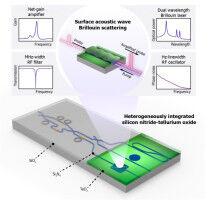
Scientists from EPFL's Galatea Laboratory make gigafemto lasers on a glass substrate.
Scientists from EPFL's Galatea Laboratory make gigafemto lasers on a glass substrate. EPFL/Jamani Caillet - CC-BY-SA 4. Scientists show that it is possible to make a femtosecond laser that fits in the palm of one's hand using a glass substrate. Is it possible to make a femtosecond laser entirely out of glass? That's the rabbit hole that Yves Bellouard , head of EPFL's Galatea Laboratory, went down after years of spending hours - and hours - aligning femtosecond lasers for lab experiments. The Galatea laboratory is at the crossroads between optics, mechanics and materials science, and femtosecond lasers is a crucial element of Bellouard's work. Femtosecond lasers produce extremely short and regular bursts of laser light and have many applications such as laser eye surgery, non-linear microscopy, spectroscopy, laser material processing and recently, sustainable data storage. Commercial femtosecond lasers are made by putting optical components and their mounts on a substrate, typically optical breadboards, which requires fastidious alignment of the optics.
TO READ THIS ARTICLE, CREATE YOUR ACCOUNT
And extend your reading, free of charge and with no commitment.
Your Benefits
- Access to all content
- Receive newsmails for news and jobs
- Post ads