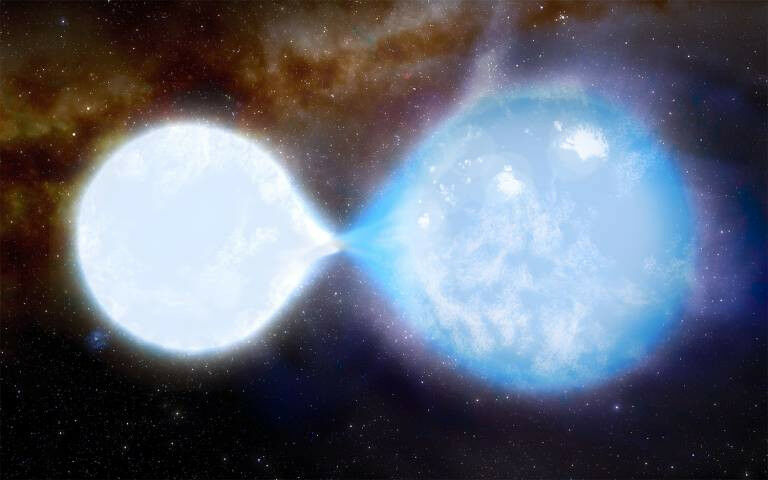
Artist’s impression of the binary star on course for a black hole merger
Artist's impression of the binary star on course for a black hole merger Two massive touching stars in a neighbouring galaxy are on course to become black holes that will eventually crash together, generating waves in the fabric of space-time, according to a new study by researchers at UCL and the University of Potsdam. The study, accepted for publication in the journal Astronomy & Astrophysics , looked at a known binary star (two stars orbiting around a mutual centre of gravity), analysing starlight obtained from a range of groundand space-based telescopes. The researchers found that the stars, located in a neighbouring dwarf galaxy called the Small Magellanic Cloud, are in partial contact and swapping material with each other, with one star currently "feeding" off the other. They orbit each other every three days and are the most massive touching stars (known as contact binaries) yet observed. Comparing the results of their observations with theoretical models of binary stars' evolution, they found that, in the best-fit model, the star that is currently being fed on will become a black hole and will feed on its companion star. The surviving star will become a black hole shortly after. These black holes will form in only a couple of million years, but will then orbit each other for billions of years before colliding with such force that they will generate gravitational waves - ripples in the fabric of space-time - that could theoretically be detected with instruments on Earth.
TO READ THIS ARTICLE, CREATE YOUR ACCOUNT
And extend your reading, free of charge and with no commitment.