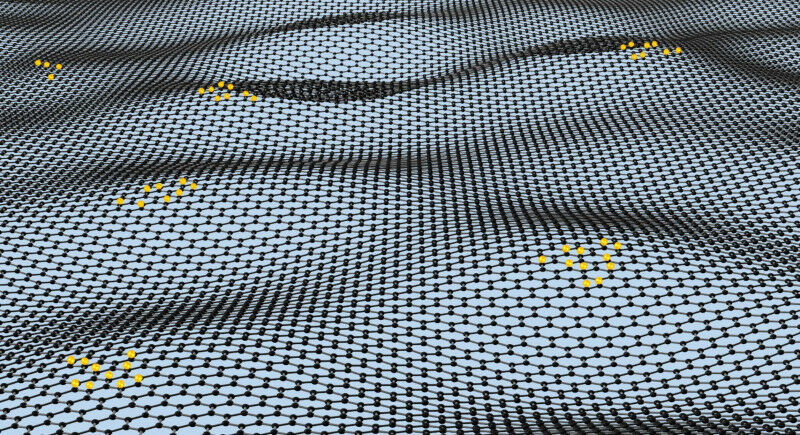
Rippled graphene with dissociated hydrogen atoms on top
Rippled graphene with dissociated hydrogen atoms on top A team of researchers led by Prof. Andre Geim from the National Graphene Institute (NGI) have discovered that nanoripples in graphene can make it a strong catalyst, contrary to general expectations that the carbon sheet is as chemically inert as the bulk graphite from which it is obtained. Published this week in the Proceedings of the National Academy of Sciences (PNAS), the research has shown that graphene with nanoscale corrugations of its surface can accelerate hydrogen splitting as well as the best metallic-based catalysts. This unexpected effect is likely to be present in all two-dimensional materials, which are all inherently non-flat. The Manchester team in collaboration with researchers from China and USA conducted a series of experiments to show that non-flatness of graphene makes it a strong catalyst. First, using ultrasensitive gas flow measurements and Raman spectroscopy, they demonstrated that graphene's nanoscale corrugations were linked to its chemical reactivity with molecular hydrogen (H2) and that the activation energy for its dissociation into atomic hydrogen (H) was relatively small. The team evaluated whether this reactivity is enough to make the material an efficient catalyst. To this end, the researchers used a mixture of hydrogen and deuterium (D2) gases and found that graphene indeed behaved as a powerful catalyst, converting H2 and D2 into HD.
TO READ THIS ARTICLE, CREATE YOUR ACCOUNT
And extend your reading, free of charge and with no commitment.