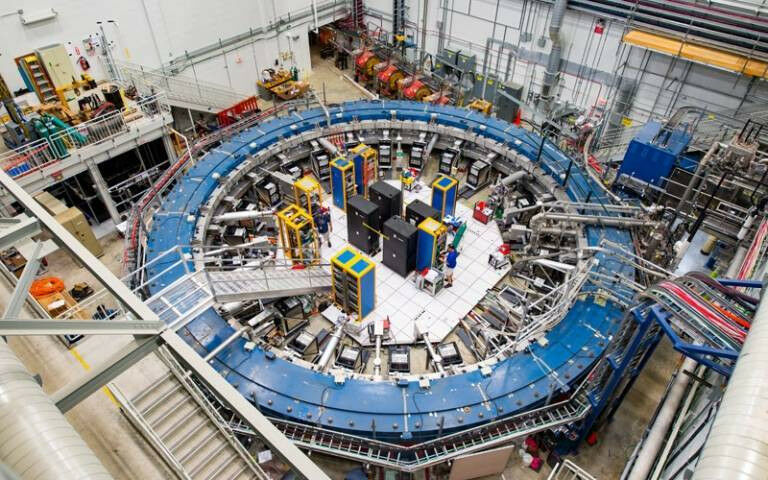
A large ring-shaped piece of equipment in a scientific laboratory.
A large ring-shaped piece of equipment in a scientific laboratory. A new, ultraprecise measurement of the subatomic muon particle's anomalous magnetic moment, conducted at US-based Fermilab and involving researchers from UCL, reinforces a discrepancy between theory and experiment that physicists can't explain, potentially hinting at new physics. The latest results, submitted to Physical Review Letters , reinforce previous measurements of the muon's magnetic moment conducted by the Muon g-2 collaboration, the international research team operating the experiment. However, the measured strength differs from theoretical predictions of it, calculated from the Standard Model of particle physics, leading to hope that there may still be undiscovered new particles of forces affecting the results. Dr Rebecca Chislett (UCL Physics & Astronomy), who led building and running the data acquisition system for the experiment, said: "These new, exciting results further reinforce our team's previous precise measurements of the muon's anomalous magnetic moment, reaching unprecedented accuracy in testing the Standard Model and probing deeper into the subatomic world." Muons are negatively charged fundamental subatomic particles, similar to electrons but about 200 times as massive. Importantly, muons are also magnetic, and wobble as they spin in the presence of a powerful magnetic field. Their magnetic moment describes how strong their inherent magnets are, and how much a surrounding magnetic field causes the particles to wobble, or "precess." The muon's magnetic moment as a function of the particle's spin is represented by the letter g, and according to theory should be a little larger than 2.
TO READ THIS ARTICLE, CREATE YOUR ACCOUNT
And extend your reading, free of charge and with no commitment.