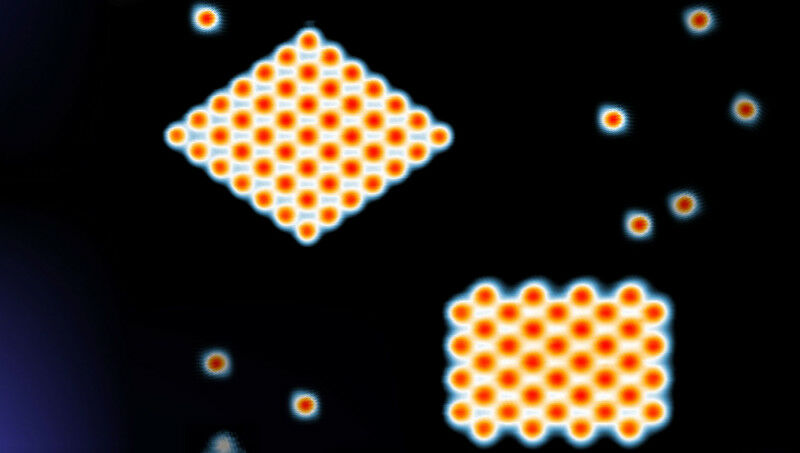
Scanning tunnelling microscope image of two of the superconducting structures created, which consist of individual chromium atoms.
Scanning tunnelling microscope image of two of the superconducting structures created, which consist of individual chromium atoms. The future of electronics will be based on novel kinds of materials. Sometimes, however, the naturally occurring topology of atoms makes it difficult for new physical effects to be created. To tackle this problem, researchers at the University of Zurich have now successfully designed superconductors one atom at a time, creating new states of matter. What will the computer of the future look like? How will it work? The search for answers to these questions is a major driver of basic physical research. There are several possible scenarios, ranging from the further development of classical electronics to neuromorphic computing and quantum computers. The common element in all these approaches is that they are based on novel physical effects, some of which have so far only been predicted in theory.
TO READ THIS ARTICLE, CREATE YOUR ACCOUNT
And extend your reading, free of charge and with no commitment.